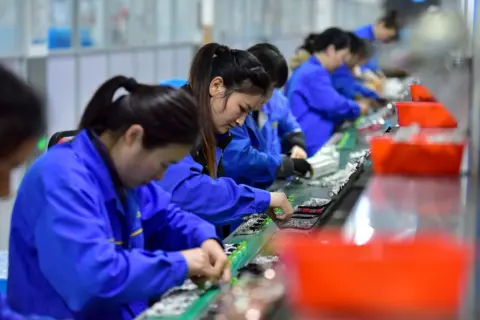
In Foshan, one of China’s major manufacturing hubs, workers gather in backstreets under trees, reflecting on their precarious livelihoods. 'No one understands what our life is like,' says a factory employee, expressing desperation amid changes in the industry from mass production to automation and advanced technology. The lingering economic impact of the US-Iran conflict has added stress to an already teetering economy, affecting factory orders and employment.
Despite past resilience amid tariffs imposed by the Trump administration, China's economy faces fresh challenges. While GDP growth stabilized around 5%, workers are left to cope with increasing costs and uncertainties about their futures. In Guangdong province, laborers are limited to low-paying jobs, earning mere dollars an hour while hoping for better opportunities.
The situation is exacerbated by the ongoing conflict in the Middle East, which is disrupting vital shipping routes and causing prices for raw materials to soar. In Guangzhou, fabric traders express concern about rising costs and dwindling orders, revealing the interconnected nature of global markets.
The impact of the Iran conflict is evident, with traders reporting increases in operational costs that threaten their slim margins. Yet amid these challenges, the Canton Fair showcases futuristic innovations from Chinese manufacturers, signifying a push towards modernization and self-reliance. The event draws international attention, suggesting that despite short-term struggles, there remains significant demand for Chinese goods, particularly in sectors like electric vehicles.
While China sits at a pivotal point in global diplomacy, advocating for a ceasefire in the Middle East, the reality feels distant for factory workers grappling with economic instability. The article serves as a poignant reminder that amidst geopolitical maneuvering, the individual stories of workers often go unheard.
Despite past resilience amid tariffs imposed by the Trump administration, China's economy faces fresh challenges. While GDP growth stabilized around 5%, workers are left to cope with increasing costs and uncertainties about their futures. In Guangdong province, laborers are limited to low-paying jobs, earning mere dollars an hour while hoping for better opportunities.
The situation is exacerbated by the ongoing conflict in the Middle East, which is disrupting vital shipping routes and causing prices for raw materials to soar. In Guangzhou, fabric traders express concern about rising costs and dwindling orders, revealing the interconnected nature of global markets.
The impact of the Iran conflict is evident, with traders reporting increases in operational costs that threaten their slim margins. Yet amid these challenges, the Canton Fair showcases futuristic innovations from Chinese manufacturers, signifying a push towards modernization and self-reliance. The event draws international attention, suggesting that despite short-term struggles, there remains significant demand for Chinese goods, particularly in sectors like electric vehicles.
While China sits at a pivotal point in global diplomacy, advocating for a ceasefire in the Middle East, the reality feels distant for factory workers grappling with economic instability. The article serves as a poignant reminder that amidst geopolitical maneuvering, the individual stories of workers often go unheard.