In brief
Recent studies published in esteemed journals show that volcanic activity occurred on the Moon's far side over 4 billion years ago, challenging existing geological theories.
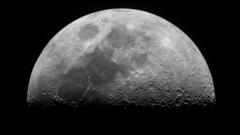
A groundbreaking study has revealed that the far side of the Moon was once alive with volcanic activity, according to findings from the Chang’e-6 mission. Researchers from the US and China, utilizing samples retrieved from this elusive lunar hemisphere, discovered basalt fragments that date back over 4.2 billion years. These insights were detailed in recent publications in the Nature and Science journals.The far side of the Moon has long been a subject of intrigue, predominantly due to its contrasting geological features compared to the near side, which is visible from Earth. While the near side’s volcanic history has been established, the geology of the far side was largely a mystery until now. The team, led by experts from the Chinese Academy of Sciences, relied on radiometric dating to pinpoint the age of the volcanic rock samples collected by the Chang’e-6 spacecraft during a challenging two-month mission.Among the notable findings was evidence of a relatively "young" volcanic eruption, estimated to have occurred about 2.83 billion years ago. This revelation is particularly significant, as such activity had not previously been identified on the Moon's near side, suggesting a more dynamic history for the far side than previously recognized. Professor Qiuli Li, from the Institute of Geology and Geophysics, remarked on the excitement of this first geochronological analysis of Chang’e-6 samples, emphasizing its importance to lunar and planetary science.Despite being called the "dark side," this region of the Moon receives ample sunlight, a misconception stemming from its tidal locking with Earth, which ensures one hemisphere never faces us. The first glimpse of this mysterious side was provided by the Soviet spacecraft Luna 3 in 1959, and various missions since have offered clearer images, including a recent NASA video showcasing the Moon with Earth in the backdrop.The Chang’e-6 mission not only marks a significant step in lunar exploration but also raises questions about future endeavors. With a wealth of knowledge to glean from the Moon’s surface, the scientific community looks forward to further investigations into its geological mysteries and the implications for understanding planetary formation and evolution.