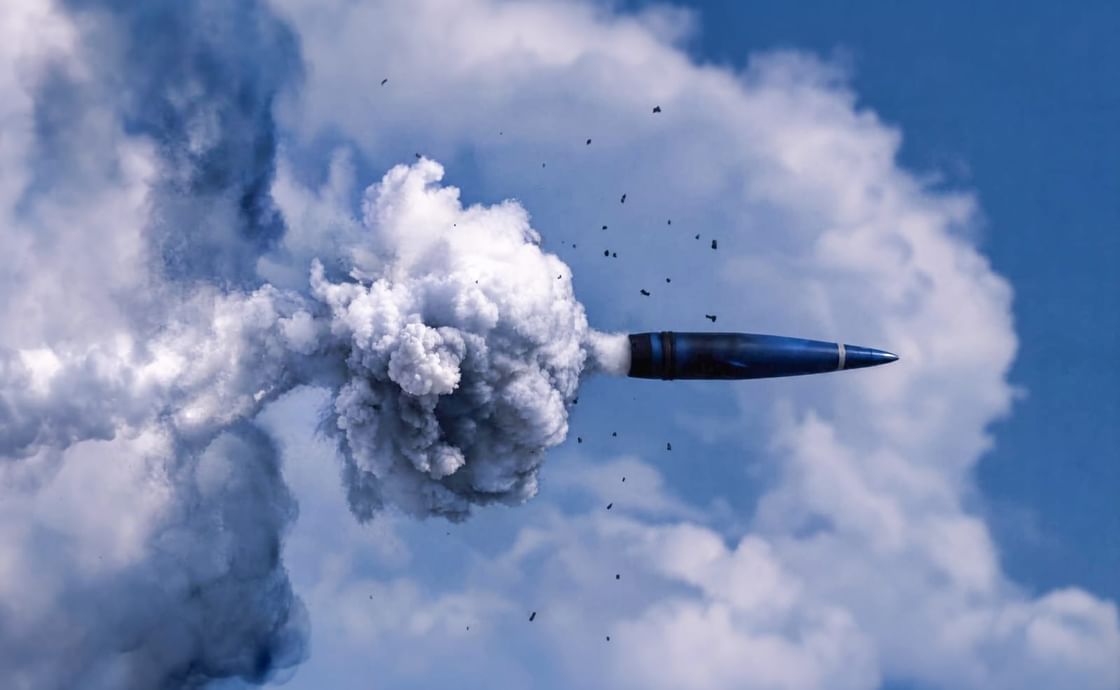
On 28 October 2026, EDGE’s ammunition arm, LAHAB, successfully performed the first dynamic test firing of its 155 mm Extended Range Full Bore (ERFB) shell in Abu Dhabi. The test, conducted from a 52‑calibre barrel, verified that the round’s chamber pressures, trajectory, and structural integrity matched theoretical expectations and complied with Joint Ballistics Memorandum of Understanding (JBMOU) standards, as well as Marine and NATO benchmarks.
The ERFB, or Extended Range Full Bore, is a shell design that extends firing distance by employing a larger propellant charge and a more aerodynamic shape. The LES includes a deep intrusion fuze well that enhances detonation reliability. By meeting JBMOU—a joint agreement that defines baseline ballistic performance—EDGE demonstrates that its rounds are compatible with existing artillery systems designed to that standard.
During the test, each round fired from the 52‑calibre barrel maintained its predicted trajectory and struck within the target area, producing consistent grouping and tight dispersion. These results confirm that chambers operated within expected pressure limits, that projectile performance matched computer‑model predictions, and that the shell’s components remained intact under firing stress.
Saif Al Dahbashi, President – Missiles & Weapons at EDGE, noted the significance of the demonstration:
This first firing confirms that chamber pressures, projectile performance, and component integrity all met our expectations. It marks the point at which our design moves from the drawing board to demonstrated performance. Artillery ammunition has become the clearest test of whether a country can supply itself, and building this capability in the UAE means our customers are not waiting in someone else’s production queue.
Following the dynamic test, the next phase is arena testing, which will quantify the round’s effectiveness in live‑fire scenarios. Subsequent qualification steps target compliance with Military Standard (MIL‑STD) requirements and NATO's Standardisation Agreement 4224, which set rigorous criteria for safety, reliability, and interoperability.
Implications for Sovereign Production
The successful test is a clear indicator that the UAE is closing the gap toward self‑sufficiency in large‑calibre ammunition. Historically, the nation has depended on foreign suppliers for 155 mm shells, creating exposure to international production queues. With EDGE’s design validated, the country can reduce that dependence, ensuring that its armed forces have assured and responsive access to artillery munitions.
Edge’s approach to sovereign capability emphasizes end‑to‑end control: designing, manufacturing, and sustaining munitions in the UAE. The programme aligns with national strategic objectives to build domestic industrial capacity in advanced defence technologies. The initiative, called HAZEEM, aims to develop an entirely UAE‑made range of artillery ammunition, reinforcing the country’s industrial self‑reliance.
Technical Benchmarks and Standards
Compliance with JBMOU, an agreement between key defence partners, is a critical milestone. The benchmark ensures that a round fired from a JBMOU‑standard barrel will perform within expected power and trajectory envelopes. By meeting this standard, EDGE guarantees that its ERFB shells can be safely used on any existing artillery platform that follows JBMOU.
In addition to JBMOU, meeting MIL‑STD requirements relates to safety and durability, ensuring robustness against extreme environmental conditions and operational stresses. NATO STANAG 4224 adds another layer, setting equivalence criteria for NATO member states to use non‑NATO ammunition without modification, thereby extending the potential customer base to allied forces.
The documented chamber pressures and projectile performance were gathered through a combination of pressure transducers and high‑speed video analysis. These measurements provide the data set that underpins future design optimisation, offering potential for incremental improvements in range, accuracy, and reliability.
With the dynamic firing successfully completed, the next steps involve real‑time weapon integration trials, where the shell will be fired from standard UAE artillery pieces to confirm performance under operational conditions. Findings from those tests will inform final engineering adjustments and guide mass‑production roadmaps.
Ultimately, the dynamic test firing marks a pivotal point on the path to a fully sovereign artillery ammunition capability, enabling the UAE to supply itself and potentially export to regional customers without reliance on external supply chains. EDGE’s achievement aligns with broader defence industrial policy objectives, demonstrating that advanced guidance and integration can be achieved within national borders.