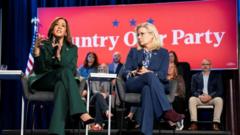
Kamala Harris spent the entirety of Monday making a direct appeal to independent and Republican voters in the pivotal states that constitute the Democratic Party’s so-called “blue wall." With just two weeks remaining until the election, Harris journeyed through Pennsylvania, Michigan, and Wisconsin alongside former Congresswoman Liz Cheney, a prominent anti-Trump Republican.
Though it was expected for Harris to focus on the most contested battlegrounds as the campaign entered its home stretch, she opted for a departure from her typical rally-style events. Instead, the two leaders engaged in a “town hall” format featuring discussions led by moderators selected to resonate with the other political side. Among these were Republican pollster and publisher Sarah Longwell in Pennsylvania and conservative commentator Charlie Sykes in Wisconsin, with the third moderator being Maria Shriver in Michigan, a member of the Kennedy family and a former first lady of California under Republican Governor Arnold Schwarzenegger.
The chosen locations in suburban counties surrounding each state's largest cities were strategic, targeting college-educated, traditionally Republican voters who have been shifting toward the Democratic party. This shift reflects a significant transformation in the support bases of the two major parties in the era dominated by Donald Trump.
Craig Snyder, a Republican strategist based in Pennsylvania and a supporter of Harris, noted that the Democrats are actively reaching out to disenchanted Republicans, yet emphasized that simply hearing from Democrats is not enough. “These voters want to hear from other Republicans,” he said. “They want to hear that they’re not alone.”
At each of the three states, Liz Cheney - who co-chaired the congressional committee that investigated the January 6 attack on the Capitol and was ousted in 2022 by a Trump-backed challenger - echoed the sentiment. “You can vote [with] your conscience and not ever have to say a word to anybody,” Cheney remarked in Michigan. “And there will be millions of Republicans who will do it.”
Harris quickly reinforced Cheney’s message, sharing her observations of Republicans approaching Cheney in gratitude for her willingness to speak against the former president, even in silence. “From my vantage point, she is not alone,” Harris asserted.
The crowds at the events reportedly included Republicans and undecided voters; although the questions presented were pre-selected, audience reactions ranging from understanding nods to surprised gasps about Trump’s political missteps hinted at a generally favorable atmosphere.
Dan Voboril, a retired schoolteacher from Wisconsin and someone grappling with concerns regarding Trump’s divisive Republican Party, disclosed his undecided status but expressed openness to supporting Harris. “Come on, Dan,” Cheney encouraged him, emphasizing that the importance of having a leader of character and principles outweighed partisanship. “If you wouldn’t hire somebody to babysit your kids, then you shouldn’t make that guy the president of the United States,” she added.
Most queries during the three-state town hall appeared tailored to allow Harris to spotlight critical campaign themes. For instance, when a young mother in Pennsylvania asked about caring for her elderly mother suffering from dementia, Harris detailed her plan for government-supported in-home nursing care. In Michigan, questions regarding Ukraine allowed both Cheney and Harris to alert the audience to the potential dangers of a Trump victory, which could weaken U.S. support in Eastern Europe amidst rising tensions.
Every stop in Harris and Cheney’s day-long tour featured inquiries about abortion and reproductive rights, prompting Cheney - who identifies as anti-abortion - to express that Republican states imposing restrictions went too far.
Current public opinion polls indicate a tightly contested presidential race, both nationally and within the battleground states of the blue wall. In 2016, Donald Trump won these traditionally Democratic states, which have deep roots in American manufacturing; however, Joe Biden reclaimed them four years later. Most surveys currently suggest that fewer than 10% of Republicans support the Democrats. Should the numbers prove understated, and as Cheney suggests, if there are Republicans who quietly dissent and ultimately vote Democratic, Harris’s path to the White House may become significantly fortified. The Harris campaign appears to have determined that the opportunity to undermine Trump’s support where it is potentially vulnerable is worthy of a concentrated effort over the course of a single day.