In brief
A PhD student's serendipitous find has led to the discovery of Valeriana, an extensive ancient Maya city buried beneath the jungles of Mexico. Utilizing Lidar technology, archaeologists discovered a complex rich in structures typically associated with urban centers, challenging previous notions about pre-Columbian life in the region.
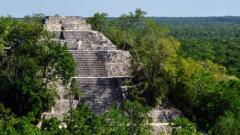
Archaeologists have made a groundbreaking discovery in the jungles of Campeche, Mexico, uncovering the remains of a vast ancient Maya city called Valeriana, believed to have housed around 30,000 to 50,000 inhabitants around 750 to 850 AD. The unexpected finding came to light when Luke Auld-Thomas, a PhD student at Tulane University, stumbled upon a laser survey online, which utilized Lidar technology — a method that employs laser pulses from aircraft to create detailed 3D maps of structures concealed beneath dense vegetation. This revolutionary technique enabled researchers to identify significant urban features, including pyramids, sports fields, and residential areas, nestled within a jungle area roughly the size of Edinburgh, Scotland. The extensive nature of Valeriana has been characterized as second in density only to Calakmul, another prominent Maya site located about 100 kilometers away. Professor Marcello Canuto of George Washington University remarks that the discovery reshapes perceptions about the sophistication of civilizations in tropical regions traditionally viewed as unsuitable for dense populations.The findings give credence to the idea that the Maya civilization was not merely composed of isolated settlements, as previously thought, but involved complex urban centers. Evidence of social structures such as plazas for religious activities, ball courts, and a reservoir indicates a well-developed society capable of supporting a large community, showcasing the advanced architecture and cultural richness of the time.Despite the significance of the discovery, the reasons behind the eventual decline and abandonment of Valeriana are still under investigation, with climate change and its effects on agriculture suspected as contributing factors. Historical contexts such as warfare and the subsequent Spanish conquest during the 16th century also loom large in discussions surrounding the Maya civilization's decline.The advent of Lidar technology is credited for revolutionizing archaeological methods, allowing researchers to survey extensive areas that would have been nearly impossible to analyze using traditional techniques. This breakthrough has resulted in the identification of numerous previously unknown sites, emphasizing the vast and complex habitation patterns of the ancient Maya.Many more undiscovered cities are likely hidden in the jungles of Mesoamerica, yet the challenge now lies in the ability to excavate and study these newfound archaeological treasures. As more cities come to light, archaeologists face the daunting task of prioritizing their efforts amidst a growing array of lost civilizations being unveiled with the help of Lidar.The research detailing this extraordinary discovery is published in the journal Antiquity, marking a significant milestone in our understanding of pre-Columbian history.