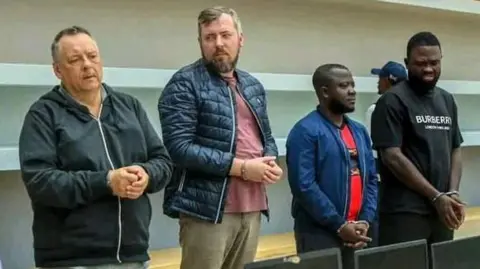
Two Russians are due to go on trial in Angola accused of stirring up anti-government protests, disinformation campaigns, and attempting to influence next year's presidential election. Arrested in August, political consultant Igor Ratchin and translator Lev Lakshtanov face eleven charges, including terrorism, espionage, and influence peddling.
The BBC has obtained a copy of the indictment detailing an alleged operation aimed at altering Angola's political trajectory. Defense attorneys contest the indictment, citing a lack of solid evidence.
According to the prosecution, Ratchin and Lakshtanov acted for Africa Politology, a covert network of operatives and intelligence agents purportedly birthed from the now-dissolved Wagner Group. This Russian group has established a presence across Africa, notably in countries like the Central African Republic, Mali, and Madagascar.
The defense claims their clients are not connected to Africa Politology or the Russian state, asserting they were simply trying to promote cultural exchanges through a proposed 'Russian House' in Luanda.
Historically, Angola's economic resources attract significant interest from Moscow, especially as the country is known for its oil and diamonds. Despite a longstanding relationship dating back to the Cold War, Angola is shifting away from Russia's influence.
In the ongoing case, two Angolans will also be tried for their involvement in the operations. Prosecutors allege they hired local operatives, an accusation which remains contested due to claims of insufficient evidence.
The upcoming trial unfolds in a context of escalating tensions; Angola experienced significant protests last July, described as the deadliest since its civil war ended in 2002, which the prosecution claims was connected to the defendants.
Amidst these developments, critics suggest the arrests may serve as scapegoats for the Angolan government, employing foreign operatives as cover for local grievances rooted in dire social conditions.
As the world watches how the trial progresses, it highlights not only the geopolitical dynamics of the region but also the complex interplay of local and international influences in Angola's political landscape.