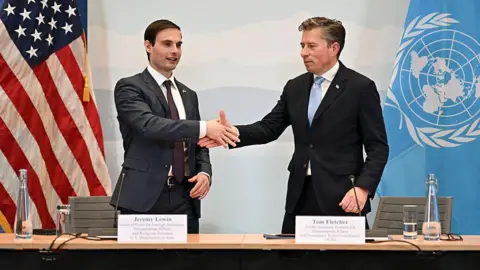
The United States has pledged $2 billion (£1.5bn) to fund United Nations (UN) humanitarian programmes, but has warned the UN it must 'adapt or die'. The announcement was made in Geneva by Jeremy Lewin, President Trump's Under Secretary for Foreign Assistance, and UN's emergency relief chief, Tom Fletcher. This funding comes amidst substantial cuts in US humanitarian operations and potential further cuts from other key donor nations such as the UK and Germany.
Mr. Fletcher lauded the new funds, stating they would save 'millions of lives'. However, the current $2 billion commitment is a mere fraction of what the US traditionally allocates for humanitarian aid; its contributions were estimated at $17 billion (£12.6bn) in 2022.
The new funding has strings attached, focusing on just 17 nations, including Haiti, Syria, and Sudan, and specifically omitting Afghanistan and Yemen. Mr. Lewin cited concerns over aid misappropriation in Afghanistan, insisting that no US taxpayer money would support terrorist groups. This approach poses difficulties for aid organizations operating in excluded regions. The US emphasis on focused, efficient funding challenges the foundational humanitarian principle of impartiality.
While the UN welcomes the financial aid amid ongoing funding crises, the politicization of such funding conditions raises significant concerns about the neutrality of humanitarian efforts. The need for effective resource allocation remains crucial as global humanitarian challenges escalate.
Mr. Fletcher lauded the new funds, stating they would save 'millions of lives'. However, the current $2 billion commitment is a mere fraction of what the US traditionally allocates for humanitarian aid; its contributions were estimated at $17 billion (£12.6bn) in 2022.
The new funding has strings attached, focusing on just 17 nations, including Haiti, Syria, and Sudan, and specifically omitting Afghanistan and Yemen. Mr. Lewin cited concerns over aid misappropriation in Afghanistan, insisting that no US taxpayer money would support terrorist groups. This approach poses difficulties for aid organizations operating in excluded regions. The US emphasis on focused, efficient funding challenges the foundational humanitarian principle of impartiality.
While the UN welcomes the financial aid amid ongoing funding crises, the politicization of such funding conditions raises significant concerns about the neutrality of humanitarian efforts. The need for effective resource allocation remains crucial as global humanitarian challenges escalate.