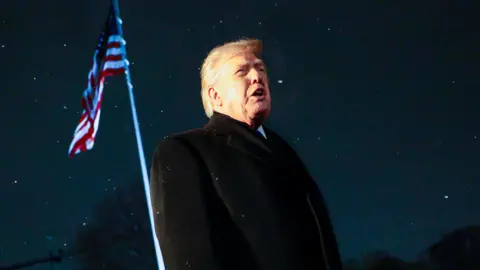
US President Donald Trump has announced he may impose additional tariffs on countries that continue trading with Iran by signing an executive order on Friday. While the order does not specify the exact rates, it uses 25% as an illustrative example and applies to goods imported into the US from any nation that 'directly or indirectly purchases, imports, or otherwise acquires any goods or services from Iran.'
Trump has reiterated his stance on preventing Iran from developing nuclear weapons, which he emphasized while addressing the press on Air Force One. This executive order arrives amidst ongoing negotiations between U.S. and Iranian officials in Oman, after weeks of escalating threats from both nations.
Earlier in the year, Trump had previously threatened a similar 25% tariff on nations conducting business with Iran, which he stated in a post on Truth Social. The lack of details regarding how these tariffs would be implemented raises questions about the practical implications of this new order.
The White House maintains that the executive order underscores the 'ongoing national emergency with respect to Iran', holding the nation accountable for its alleged pursuits of nuclear capabilities and support for terrorism. As of yet, there has been no reaction from Iran in response to the executive order.
Ongoing discussions in Oman represent the first high-level contact between U.S. and Iranian officials since a period of military escalations in mid-2023, involving notable figures such as Iranian Foreign Minister Abbas Araghchi and U.S. Special Envoy Steve Witkoff.
Rising tensions have driven fears of potential conflict, with Trump warning of severe repercussions if a deal on Iran's nuclear program is not reached. Meanwhile, Iran continues to assert that its nuclear agenda is strictly peaceful, denying any ambition to develop nuclear weapons.
Trump has reiterated his stance on preventing Iran from developing nuclear weapons, which he emphasized while addressing the press on Air Force One. This executive order arrives amidst ongoing negotiations between U.S. and Iranian officials in Oman, after weeks of escalating threats from both nations.
Earlier in the year, Trump had previously threatened a similar 25% tariff on nations conducting business with Iran, which he stated in a post on Truth Social. The lack of details regarding how these tariffs would be implemented raises questions about the practical implications of this new order.
The White House maintains that the executive order underscores the 'ongoing national emergency with respect to Iran', holding the nation accountable for its alleged pursuits of nuclear capabilities and support for terrorism. As of yet, there has been no reaction from Iran in response to the executive order.
Ongoing discussions in Oman represent the first high-level contact between U.S. and Iranian officials since a period of military escalations in mid-2023, involving notable figures such as Iranian Foreign Minister Abbas Araghchi and U.S. Special Envoy Steve Witkoff.
Rising tensions have driven fears of potential conflict, with Trump warning of severe repercussions if a deal on Iran's nuclear program is not reached. Meanwhile, Iran continues to assert that its nuclear agenda is strictly peaceful, denying any ambition to develop nuclear weapons.