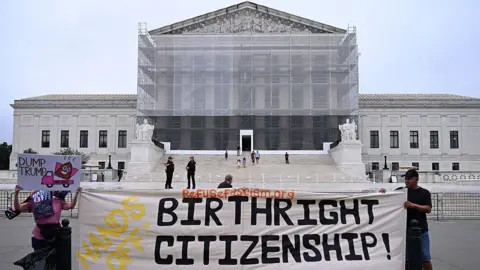
The U.S. Supreme Court has announced its decision to hear arguments regarding the constitutionality of President Trump’s birthright citizenship order, which asserts that children born in the United States to parents who are in the country illegally or temporarily do not automatically receive American citizenship. This case challenges more than 125 years of established understanding of the 14th Amendment, which confers citizenship to anyone born on U.S. soil with narrow exceptions.
The Court's review stems from a lower court ruling that deemed the citizenship restrictions unconstitutional. Currently, these restrictions remain unenforced and a definitive ruling is expected by early summer following the spring hearings. The implications of this case extend beyond the immediate parties involved, potentially impacting millions of children born to noncitizen parents.
The administration has thus far faced various legal challenges, highlighting a pre-existing divide before the high court. In a past ruling, lower courts ruled against the executive order on grounds of it likely violating the Constitution, particularly the rights enshrined in the 14th Amendment.
Supporters of the order argue that the citizenship clause was not intended to apply to children of noncitizens and has garnered backing from numerous states and lawmakers, reflecting significant political dimensions to the legal debate.
As the nation anticipates the Supreme Court's decision, the case serves as a touchstone in the ongoing discussions pertaining to immigration reform, civil rights, and the future interpretation of constitutional law.
The Court's review stems from a lower court ruling that deemed the citizenship restrictions unconstitutional. Currently, these restrictions remain unenforced and a definitive ruling is expected by early summer following the spring hearings. The implications of this case extend beyond the immediate parties involved, potentially impacting millions of children born to noncitizen parents.
The administration has thus far faced various legal challenges, highlighting a pre-existing divide before the high court. In a past ruling, lower courts ruled against the executive order on grounds of it likely violating the Constitution, particularly the rights enshrined in the 14th Amendment.
Supporters of the order argue that the citizenship clause was not intended to apply to children of noncitizens and has garnered backing from numerous states and lawmakers, reflecting significant political dimensions to the legal debate.
As the nation anticipates the Supreme Court's decision, the case serves as a touchstone in the ongoing discussions pertaining to immigration reform, civil rights, and the future interpretation of constitutional law.