Spanish rail authorities have temporarily reduced the speed limit on part of the high-speed line between Madrid and Barcelona after a fault was detected on the track. Transport Minister Óscar Puente said a crack had been found on Sunday night in the line 110km (68 miles) west of Barcelona, between Alcover and l'Espluga de Francolí, in the Catalonia region.
This measure follows a tragic high-speed collision earlier this month that left 45 people dead and amidst reports of severe disruption to local rail services in the northeast of the country.
The transport ministry has assured that the fault in the line does not jeopardize the safety of trains traveling along it and that service will continue.
The new speed limit has been set to 80km/h (50mph) indefinitely, a stark contrast to high-speed trains that can reach speeds of 300km/h. This modification is one of several responses to concerns about safety on high-speed lines after the recent tragic accident.
Moreover, last week, several sections of the Madrid-Barcelona line experienced temporary speed reductions to 230 km/h as drivers reported vibrations and other anomalies, although the limit was restored after inspections. Additionally, parts of the Madrid-Valencia line have been temporarily limited to speeds of 160km/h and 200km/h.
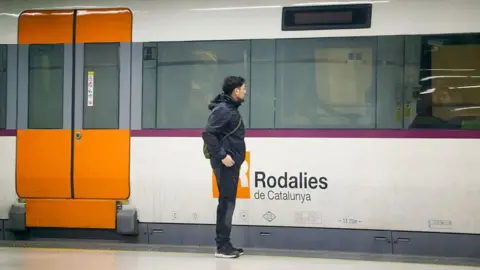
The local Rodalies rail service in Catalonia has faced significant disruptions. Following an incident last week where a trainee driver was killed by a collapsing wall, further chaos ensued as two separate incidents led to temporary service suspensions. There is speculation regarding the potential for cyberattacks, although the government has not confirmed this.
The situation has drawn criticism from local politicians, with calls for increased investment in the aging Rodalies network, highlighting chronic underfunding as a significant issue. The transport minister is expected to address Congress regarding the ongoing rail crisis.
As investigations continue into the deadly Adamuz crash, which was caused by a section of track breaking loose before a collision, authorities face mounting pressure regarding the safety and reliability of Spain’s rail services.