In brief
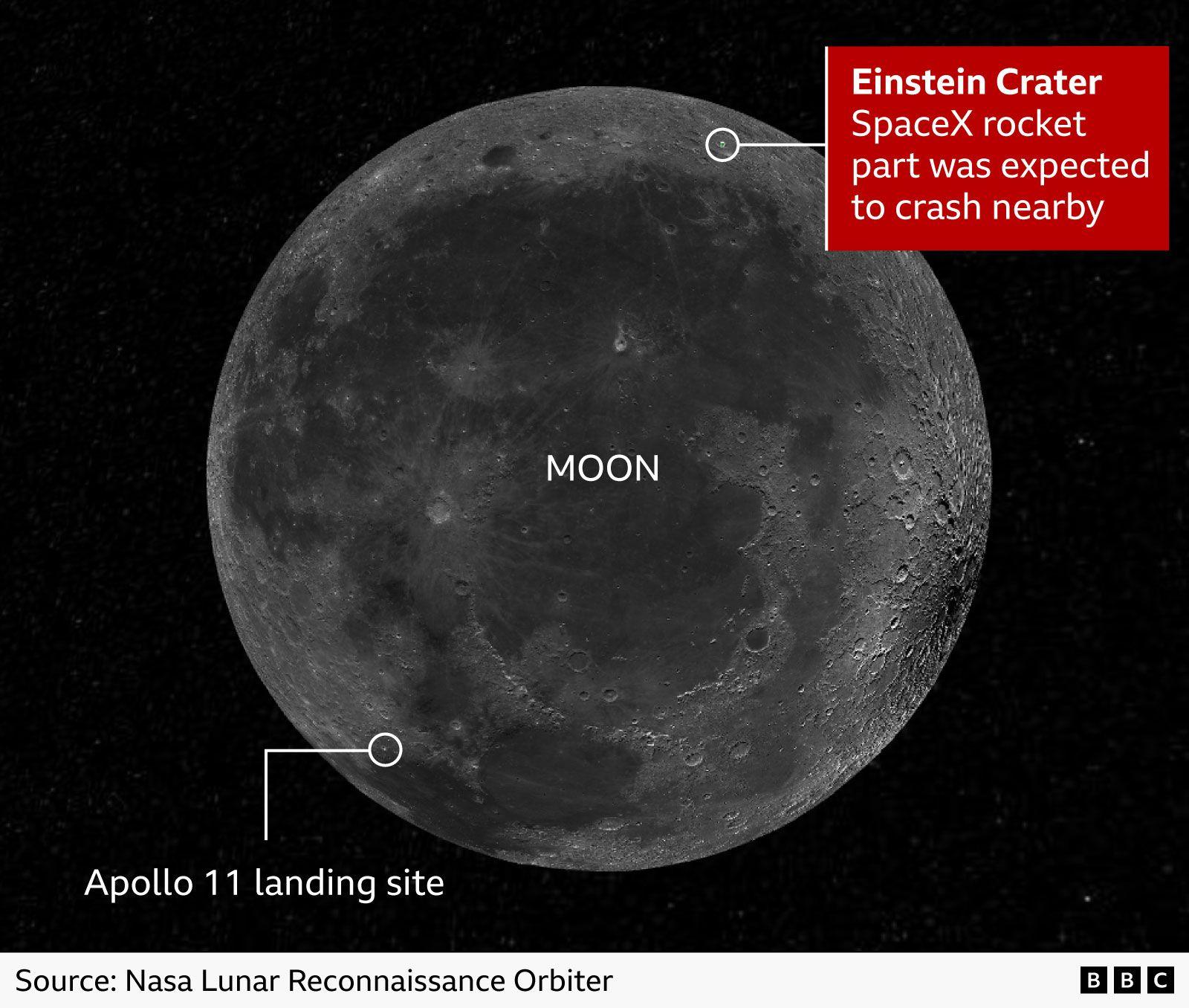
In early August 2026 the empty upper stage of a SpaceX Falcon 9 rocket slammed onto the Moon at about 8,700 km/h, forming a fresh crater just north of the Einstein crater. Although the fireball was too brief for amateur observers, orbiters such as NASA’s Lunar Reconnaissance Orbiter will soon photograph the site, allowing scientists to compare pre‑ and post‑impact imagery. The well‑defined size, speed and impact point turn this accidental collision into a carefully controlled laboratory experiment, letting planetary scientists test models of crater formation, ejecta distribution and seismic wave propagation. Insights gained could inform future lunar landers and help assess the hazards posed by tumbled space debris near the Moon.
On 5 August 2026 the upper stage of a SpaceX Falcon 9 rocket slammed into the Moon at roughly 8,700 km/h, creating a new crater just north of the Einstein crater.
The empty, approximately 70‑metre‑tall, 4,000‑kg stage of the reusable Falcon 9 had been shed when it delivered two lunar landers into orbit in January 2025. After release it slipped into an extended, looping orbit that eventually nudged it toward the Moon.
While the bright flash produced by the impact lasted a fraction of a second and was too faint for even large telescopes, NASA’s Lunar Reconnaissance Orbiter will soon capture images before and after the collision, enabling scientists to identify the exact shape and depth of the new crater.
Because the impact’s conditions are known—a well‑defined mass, speed and impact site—planetary scientists can treat this event as a controlled experiment. They will use it to refine models of how impactors carve craters, throw ejecta across the lunar surface, and generate seismic waves within the Moon’s interior.
Understanding the debris distribution and ground shaking in such a scenario is also critical for designing future lunar landers and establishing safe distances for Moon bases.
Beyond its immediate scientific value, this crash adds to a long history of human‑made objects striking the Moon, ranging from early Soviet Luna probes to deliberate NASA missions that sought to reveal subsurface ice.
For now, the tiny 14‑metre‑wide fragment will be a new frontier for remote sensing and impact science, turning an accident into a wealth of data for lunar exploration.