Russia has confirmed that it used the Oreshnik ballistic missile as part of a massive overnight strike on Ukraine on Thursday night.
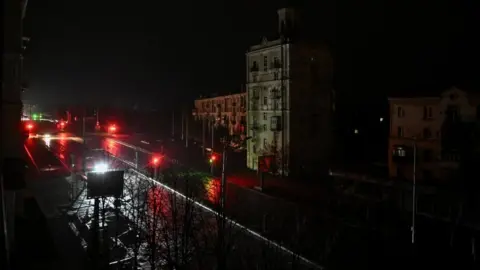
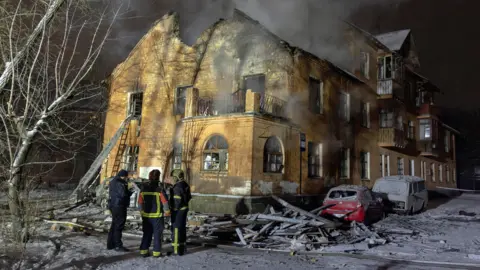
Four people were killed and 25 others injured in Kyiv, where loud booms could be heard for several hours, setting the sky alight with explosions.
This marks only the second use of the Oreshnik, which was first deployed in November last year against the central city of Dnipro.
According to Russia's defence ministry, the strike was a response to a Ukrainian drone attack allegedly targeting Vladimir Putin’s residence in late December, a claim Kyiv has denied.
While the ministry did not specify the Oreshnik's target, videos circulating on social media prior to midnight depicted numerous explosions on the outskirts of Lviv. Ukrainian authorities confirmed that a ballistic missile hit infrastructure in Lviv, located about 60km (40 miles) from the Polish border.
The Oreshnik is described as an intermediate-range hypersonic missile capable of reaching up to 5,500km (3,417 miles). Its design allows for a warhead that fragments during descent, creating multiple targeted projectiles that cause successive explosions.
Ukrainian foreign minister Andrii Sybiha characterized the strike as a grave threat to security in Europe. He called out the apparent justification of Putin’s alleged hallucinations related to the drone attack.
A paramedic was among those killed while responding to the destruction in Kyiv, with the city’s mayor, Vitali Klitschko, describing the event as a "double-tap" attack intended to harm those rescuing the injured.
The strike caused significant power supply disruptions in several Kyiv neighborhoods, amid a harsh winter, where temperatures are expected to plummet to -15C (5F).
Additionally, as Moscow escalated its strikes, Ukrainian forces launched counterattacks on Russian infrastructure. Reports indicated that approximately half a million people in the Russian region of Belgorod faced power outages due to Ukrainian operations against local energy facilities.