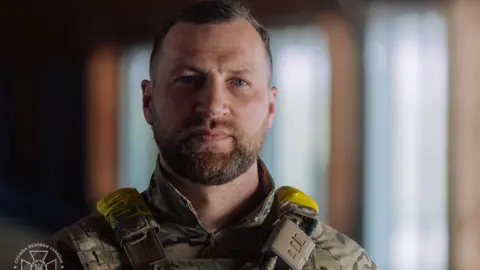
President Volodymyr Zelensky has reshuffled the leadership of Ukraine's Security Service (SBU), replacing influential Vasyl Malyuk and nominating Maj-Gen Yevhenii Khmara as the acting head.
The SBU is primarily concerned with internal security and counter-intelligence and, since the beginning of Russia's full-scale invasion in 2022, it has also played a prominent role in assassinations and sabotage attacks deep inside Russia.
Malyuk, who had run the SBU since 2022, gained a reputation for overseeing successful operations against Russia and for purging the SBU from alleged Russian double agents.
The latest reshuffles are part of a long series of changes made by Zelensky since the start of the war.
Malyuk's name is well-known across Ukraine. He coordinated the daring Spider Web attack on Russian air bases last year, and Khmara was also involved in that operation. His dismissal has been met with criticism, with the perception that Zelensky's decision was short-sighted. Reports suggest Malyuk initially refused to resign.
Despite his dismissal from the SBU chief position, Malyuk has been asked to continue leading operations against Russia, as Zelensky emphasized the need for more asymmetric operations. Khmara's appointment, however, has somewhat alleviated fears regarding the SBU's future effectiveness. Yet, some analysts warn that Khmara's expertise may not translate well to a leadership role over the entire SBU.
The recent changes also involve former spy chief Kyrylo Budanov becoming Zelensky's new chief of staff, which some believe influenced Malyuk's dismissal. Former SBU operative Ivan Stupak noted tensions between Malyuk and Budanov, suggesting Budanov's input played a role in this reshuffling.
Others, like Oleksandr Notevskyi from the Ukrainian Center for Policy Development, support Khmara's appointment, citing his experience in elite operations within the SBU.
Khmara's appointment requires confirmation from the Ukrainian parliament. As Ukraine continues to grapple with its military strategies against Russia, analysts emphasize the importance of a leader capable of addressing the challenges posed to the country's security.
Last week, Zelensky also named a new defense minister and replaced Budanov with foreign intelligence chief Oleh Ivashchenko. These ongoing adjustments to his team have faced scrutiny as Ukraine navigates its current wartime landscape.
In his analogy, Stupak likened Zelensky's decisions to a football manager making repetitive substitutions, suggesting a diminishing pool of effective leaders to call upon during this critical period.