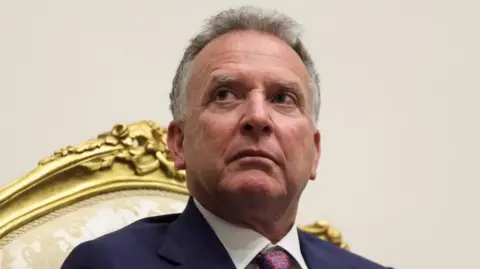
German Chancellor Friedrich Merz said the latest peace plan draft for Ukraine has been presented to US President Donald Trump - including a proposal on territorial concessions Kyiv may be prepared to make.
But Merz highlighted the territorial issue was 'a question that must be answered primarily by the Ukrainian president, and the Ukrainian people.'
'We also made this clear to President Trump,' Merz pointed out.
In recent weeks, European leaders have worked closely with Ukraine to come up with a new iteration of a peace plan that addresses Kyiv's interests and concerns.
Trump appears to have grown frustrated with the intricacies of the question of sovereignty over Russian-occupied Ukrainian territories. Because his negotiating team has worked closely with Moscow, Kyiv's European allies fear the US president might eventually seek to impose a Russian-led solution on Ukraine.
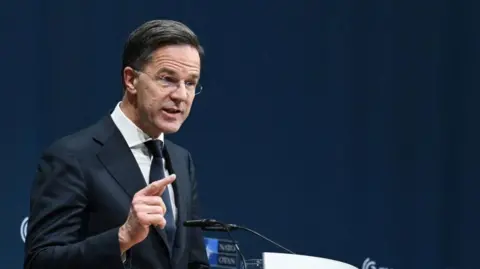
'It would be a mistake to force the Ukrainian president into a peace that his people will not accept after four years of suffering and death,' Merz said in a joint news conference with NATO chief Mark Rutte.
He added that in Wednesday's 'constructive' phone call with Trump, he, France's Emmanuel Macron, and UK Prime Minister Sir Keir Starmer had 'made it clear' that Europeans needed to have their interests heard too.
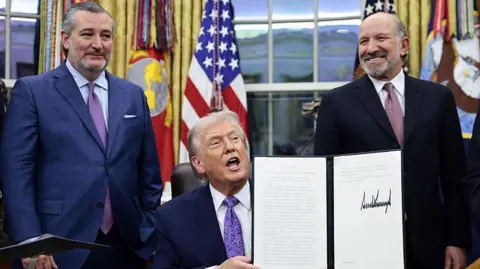
For his part, Trump stated that the participants had 'discussed Ukraine in pretty strong words' and mentioned he was yet to decide whether to attend a meeting in Europe, saying, 'We don't want to be wasting time.'
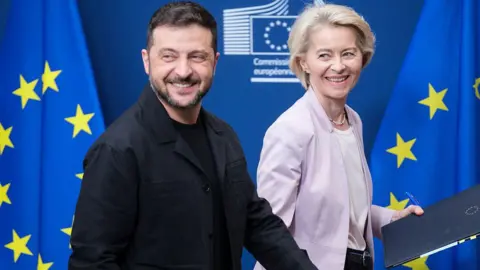
Ukraine's President Volodymyr Zelensky has expressed openness to direct discussions with Trump regarding the issues at play, but Trump has suggested that all points must be resolved before any meeting.
The territorial question remains contentious, as Russia demands Ukraine withdraw from parts of the eastern Luhansk and Donetsk regions - a proposition that Kyiv staunchly opposes, fearing it would enable further Russian aggression.
'We have no legal right to [cede territory], under Ukrainian law, our constitution and international law,' Zelensky stated earlier this week. 'And we don't have any moral right either.'
Zelensky is scheduled for further discussions with allies as he co-chairs a coalition alongside Merz, Macron, and Starmer.
While diplomatic activities escalate among US, European, and Ukrainian officials, Russia has remained relatively silent. Their comments suggest alignment with Washington's hopes for peace.
Foreign Minister Sergei Lavrov praised Trump's attempts to mediate and asserted that recent meetings have resolved misunderstandings from previous summits.
Lavrov dismissed suggestions of Ukraine receiving security guarantees via foreign troops, asserting that Moscow has put forward additional security proposals and guarantees against aggression towards NATO or EU states.
However, Ukraine and its European allies insist that without solid security assurances, any peace agreement could be ineffective. Zelensky indicated readiness to hold elections if security can be guaranteed, after suspending elections due to martial law.
NATO chief Mark Rutte reiterated that many allies do not perceive the urgency of the Russian threat, warning, 'We are Russia's next target,' and stressing the need to prevent a major conflict in Europe.