In brief
NASA is rolling out its giant Space Launch System (SLS) to the launch pad for the second time as part of its Artemis II mission, which aims to send astronauts around the Moon. After resolving a helium system issue that halted an earlier launch attempt, engineers are set to conduct final checks before targeting April 1 for launch.
NASA is rolling out its giant Moon rocket to the launch pad for a second time, ahead of a mission to send astronauts around the Moon – something not attempted in more than 50 years.
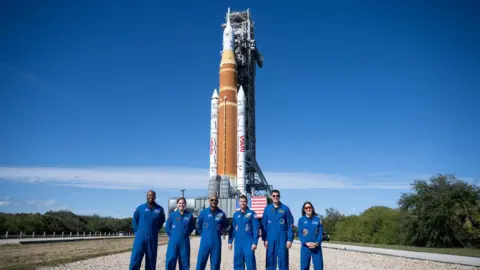
The 98m tall Space Launch System (SLS) and Orion spacecraft are making the four-mile journey from their assembly building to Pad 39B at the Kennedy Space Center in Florida.
The move comes after a problem with the rocket's helium system forced NASA to abandon a launch attempt in March and return the vehicle indoors for repairs. Engineers say the issue has now been fixed and hope that a series of final tests at the pad will confirm the rocket is ready for an early-April launch window.
Just after nightfall, the SLS emerged from the Vehicle Assembly Building (VAB) – one of the largest buildings in the world – and began its slow crawl towards the Atlantic coast. Standing taller than Big Ben's clock tower at nearly 100m, the rocket and its launch platform weigh about 5,000 tonnes. They are being carried by Crawler-Transporter-2, a low-slung vehicle built in 1965 to transport Saturn V Moon rockets to the pad. The maximum speed is about 1mph (1.6km/h), and the four-mile journey can take up to 12 hours.
Once the rocket reaches the pad, engineers will spend several days checking repairs and conducting tests on the troubled helium system, which is vital for pressurizing the propellant tanks. They will also run through parts of the countdown procedure before the earliest launch window opens on April 1.
The Artemis II crew – Reid Wiseman, Victor Glover, Christina Koch, and Jeremy Hansen – are currently in pre-flight quarantine and will participate in rehearsals leading up to the launch. This historic mission aims to loop around the Moon before returning to Earth and paves the way for future Artemis missions, including one planned to land astronauts on the Moon in 2028.