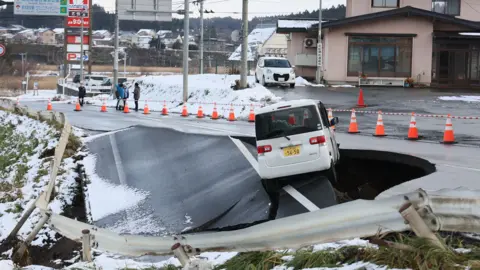
At least 30 people were injured after a magnitude 7.5 earthquake hit north-eastern Japan on Monday night, forcing thousands of people to evacuate their homes.
The quake occurred at 23:15 (14:15 GMT) at a depth of 50km (31mi), about 80km off the coast of the Aomori region, according to the Japan Meteorological Agency. It prompted tsunami warnings which have now been lifted, while waves of 70cm (27in) were observed.
Some train services have been suspended and thousands of homes have been left without power due to the quake.
Authorities have warned that a stronger tremor could occur in the coming days, urging the public to remain on high alert for at least a week, according to local media reports.
In a statement addressed to citizens affected by the earthquake, Japanese Prime Minister Sanae Takaichi emphasized the importance of earthquake preparedness, advising residents to secure furniture and be ready to evacuate immediately.
With about 90,000 residents ordered to evacuate and approximately 2,700 homes lacking power, East Japan Railway has suspended some services along the north-eastern coast.
The Japanese government has established a response office within the Prime Minister's crisis management center and convened an emergency team, as chief cabinet secretary Minoru Kihara confirmed.
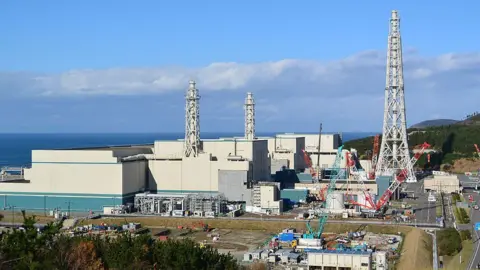
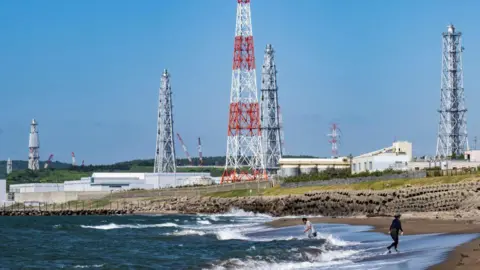
In terms of nuclear safety, Tohoku Electric Power reported no irregularities at its Higashidori and Onagawa nuclear power facilities. Likewise, no abnormalities were detected at the disabled Fukushima nuclear power plant site, which had previously suffered severe damage during the catastrophic 9.0 earthquake in March 2011.
Japan remains one of the most earthquake-prone countries in the world. Situated on the Pacific Ring of Fire, it experiences about 1,500 earthquakes annually. The country's earthquake investigation panel has indicated a 60-90% chance of a megaquake occurring in the Nankai Trough within the next three decades, which could result in immense damage and loss of life.