Iran’s Grand Funeral Carries a Message of Revenge and Resistance
Three days of public mourning in Tehran for the slain Supreme Leader ended with one of the most spectacular political displays the new Iranian leadership has ever mounted for the world. The hulking funeral cortège carried the coffins of Ayatollah Ali Khamenei and four family members along a 10‑km route, often halted by millions of mourners in one of the largest gatherings in years.
The procession – carefully choreographed in a manner steeped in resistance and revenge – carried political messaging that many felt was directed at the United States and Israel. The crowds chanted slogans such as “death to America” and “death to Israel” while the custodians of the Supreme Leader’s legacy attempted to frame him as a transcendent figure whose authority spanned the Muslim world.
Many Iranians, however, chose not to attend. The country had been ravaged by two wars in less than a year, its inflation hovering around 80%, and its people were still reeling from the January uprisings. Some accused Khamenei of the security crackdown that killed thousands, labeling his legacy as one of excess.
During the Monday procession, aerial footage showed a road chock‑full of loyalists who consumed the sense of loss and forward‑looking anger with chants that echoed the Islamic Republic’s key slogans. In the process, Government supporters visited foreign journalists and social media users to urge them to “tell the truth.”
In the afternoon, as the crowd gathered at the route’s many “mookebs” – free food and water stations – a grey‑haired man named Mojtaba declared a message to President Trump and the world. He warned that “soon…you will see signs of revenge at the top of the White House” and urged that “the colour of the White House will be the colour of my red flag.”
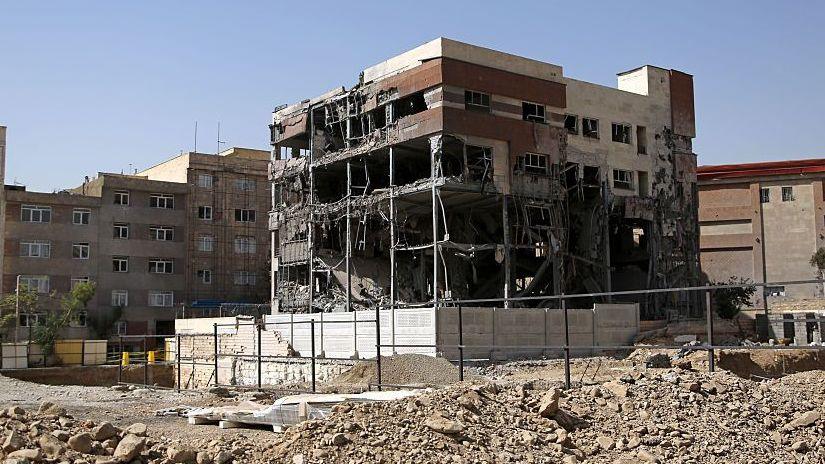
Another front‑line message appeared in the way the coffins were carried. The five caskets were painted with Iran’s flag colours – green, red and white – and a small coffin for Khamenei’s 14‑month‑old granddaughter was included. The tragedy is further underscored by all the family members being killed by Israeli‑American air strikes the first day of the war – a detail that the funeral procession had not shied away from showing.
The funeral was also used by officials to send postcards of the new regime’s political stance to the world. Posters in English highlighted Trump as a main target, while through messaging apps slogans like “Our revenge is inevitable” circulated.
Beyond the procession, the funeral will coincide with the transportation of Khamenei’s body to several sacred sites: Qom the next day, then the holy cities of Najaf and Karbala in neighboring Iraq, and finally a burial at the Imam Reza Shrine in Mashhad, the revered city of the Prophet. These steps were intended to foster solidarity with the wider Shia community.
The political leaders remember the betterment of national security while dealing with a severe economic crisis. The new leadership must now negotiate if it wants further sanctions relief and the unfreezing of assets. (The BBC’s chief international correspondent Lyse Doucet is reporting from Tehran on condition that the BBC’s Persian Service cannot publish these images.)
In all, the funeral served not only as a grieving moment but also as a stark demonstration that the new leadership does not acknowledge any change in the political vision and will remain unyieldingly hardline. The street ahead remains uncertain, but the left‑wing supporters continue to signal that a new era of resistance and revenge may follow the death of the first-generation founders of the 1979 revolution.