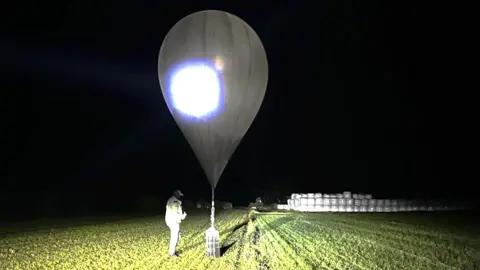
Lithuania is facing a peculiar crisis as giant balloons launched from Belarus have begun crossing into its territory, carrying crates of contraband cigarettes. This unusual method of smuggling has led to the closure of Lithuania's main airport on numerous occasions, stranding passengers and delaying flights.
The balloons have become a symbol of increased tensions between Lithuania and Belarus, prompting Lithuanian officials to label them as instruments of hybrid warfare. These concerns arise amid broader geopolitical pressures as Belarus, backed by Russia, appears to be utilizing smuggling operations to undermine Lithuania's security.
Over a period of ten weeks, Lithuania has recorded more than fifteen instances where airport operations were halted due to these balloon intrusions. On one notable occasion, airspace was completely closed for eleven hours, raising alarms about the country's safety protocols. The Lithuanian government suspects that these balloon launches are not simple smuggling attempts but a form of political intimidation orchestrated by Belarusian authorities.
In response, Lithuania has declared a state of emergency and ramped up security measures along the border. Military patrols have been deployed to intercept any potential smuggling activities, as authorities fear that the situation could escalate further. Officials point out that launching balloons directly targeting the main airport suggests a calculative intent rather than mere smuggling.
As the backdrop of these developments includes ongoing geopolitical strife in Eastern Europe, the Lithuanian Foreign Minister Kestutis Budrys emphasized that the balloons might serve to exert pressure on the EU regarding sanctions against Belarus, enhancing the perception of Belarus as a hostile neighbor.
With the possibility of more such incursions on the horizon, Lithuania's response strategies are continuously evolving. Current countermeasures include utilizing military radar to track balloon movements and offering significant rewards for solutions to intercept these airborne contraband carriers. As travel disruptions grow, passenger confidence in aviation safety is at risk, with some expressing concerns about the unpredictability of flights in such an environment.
This unusual threat form serves as a reminder of the complexities of modern conflict, where hybrid tactics like balloon-based operations can disrupt security, provoke diplomatic tensions, and challenge the effectiveness of existing defense mechanisms.