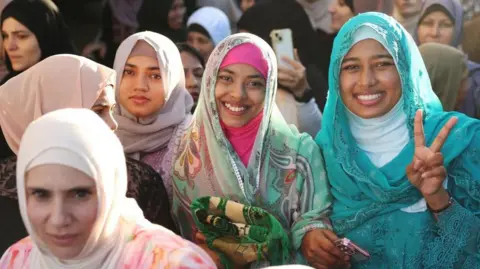
As sunset approached in the south-western Sydney suburb of Lakemba last week, the street outside the Imam Ali bin Abi Taleb Mosque filled with thousands of people - most of whom found a seat at one of many trestle tables covered with white table cloths.
The mosque was hosting a community Iftar: the evening meal that marks the end of daily fasting in Ramadan. The tables were divided into sections, marked by buffet stations labelled 'women' and 'men', and as the sun went down, families brought out boxes of dates to break their fast, offering them around to neighbours and other guests.
Yet despite the family-friendly vibe of this event, a police surveillance trailer parked in the road - complete with 360 cameras on tall poles - spoke to fears among the community. After being on the receiving end of several threats, community leaders requested extra police presence throughout Ramadan. They also employed private security.
We are going through very challenging times at the moment for the Muslim community and Australia in general, said Gamel Kheir, secretary of the Lebanese Muslim Association, who organised the community Iftar. If ever there was a need for communities to come together and break bread, I would say this year is more [important] than ever.
Islamophobia is on the rise in Australia. Threats towards Muslims used to average around 2.5 cases a week, according to the Islamophobia Register Australia. But since the Hamas attack on Israel on 7 October 2023, reported incidents have increased by 636%.
Meanwhile, the Executive Council of Australian Jewry notes that incidents of antisemitism are nearly five times higher than they were before the attacks. Last year's Bondi Beach massacre, where two gunmen targeted a public Hannukkah celebration, has further exacerbated both fear and hate in the community.
Reported incidents of Islamophobia have now surged to an average of 18 cases a week, with the threats contributing to a pervasive atmosphere of anxiety within the Muslim community.
Community leaders argue that racism is being legitimized by certain political figures, reinforcing divides and catalyzing fear. We're talking astronomical figures, Kheir noted, stressing that many incidents go unreported. The fear that I have is Pauline Hanson and her dog whistling has such an effect on the Labor and Liberal Party that they are too scared to take the defence of the Muslim community, because it's political suicide for them, he added.
As Lakemba's diverse Muslim community gathers for Eid celebrations, the contrasting reality of increasing Islamophobia serves as a poignant reminder of the communal solidarity required in such trying times.