In brief
With the absence of Russian officials from the upcoming Auschwitz ceremony, the country's memorialization of WWII has pivoted towards acknowledging the suffering of all Soviet citizens rather than focusing on the specific genocide of Jews. This shift reflects broader geopolitical narratives and has sparked controversy regarding the portrayal of historical events.
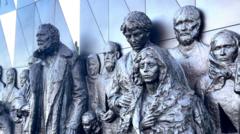
On the outskirts of St Petersburg stands a towering memorial dedicated to the Soviet civilians who fell victim to Nazi atrocities during World War II. This site, soaring over 40 meters, features a poignant statue of a mother with her children, representing the ripple effects of human suffering. Below, an eternal flame burns near the names of infamous concentration and extermination camps such as Auschwitz and Treblinka, yet this monument intentionally shifts the narrative away from the Holocaust towards a broader representation of suffering endured by the Soviet populace.President Vladimir Putin inaugurated this memorial on January 27, marking two significant anniversaries: the Red Army's liberation of Leningrad in 1944 and the subsequent liberation of Auschwitz in 1945. While this date is globally recognized as International Holocaust Remembrance Day, Putin's speech at the memorial focused on the "genocide of the Soviet people," omitting direct references to the Holocaust's unique context of antisemitic genocide.Despite ongoing commemorations of the Holocaust within Russia, the overarching narrative is gradually pivoting toward acknowledging the massive toll of the Great Patriotic War on the Soviet Union, wherein over 27 million Soviet civilians perished. Russian officials have reframed their discussions, often portraying Russians as collective victims of historical aggressors, particularly in light of recent geopolitical tensions exacerbated by the war in Ukraine.Critics, including Israeli Ambassador to Moscow Simone Halperin, emphasize the critical distinction in acknowledging the Holocaust as a systematic genocide aimed specifically at Jews. Historian Konstantin Pakhaliuk notes that the current approach is to bolster a victim narrative for Russians, suggesting that being perceived as victims absolves them of historical responsibility.In stark contrast to Putin's earlier statements, such as those made during the 60th anniversary of Auschwitz's liberation, the contemporary Russian discourse lacks specificity regarding the Holocaust. Twenty years ago, he acknowledged the tragedy of the Holocaust as a shared catastrophe for humanity, yet today’s rhetoric shifts towards a nationalistic view of victimhood.As the 80th anniversary approaches, Russian officials have not been invited to participate in commemorative events, reflecting deteriorating relations with Poland and the broader international community. Auschwitz Museum director Piotr Cywinski articulates this distance by asserting that Russia's current stance undermines the value of freedom.The decision to exclude Russia has faced backlash from influential figures within the Russian Jewish community. Rabbi Alexander Boroda, president of the Federation of Jewish Communities of Russia, criticized the lack of invitation as disrespectful to the memories of those who fought fascism, underscoring the importance of collective historical memory.Jewish organizations in Russia remain proactive in their efforts to educate citizens about the Holocaust, particularly as instances of denialism rise globally. Anna Bokshitskaya of the Russian Jewish Congress highlights the urgent need for remembrance and awareness to prevent the repetition of past atrocities.