Late one night last month, Iang Za Kim heard explosions in a neighboring village, then fighter jets flying overhead. She ran out of her home to see smoke rising from a distance. We were terrified. We thought the junta's planes would bomb us too. So we grabbed what we could – some food and clothes and ran into the jungles surrounding our village.
Iang's face quivers as she recounts the story of what happened on 26 November in K-Haimual, her village in Myanmar's western Chin State, and then she breaks down. She's among thousands of civilians who've fled their homes in recent weeks after the Burmese military launched a fierce campaign of air strikes, and a ground offensive in rebel-held areas across the country, to recapture territory ahead of elections starting on 28 December.
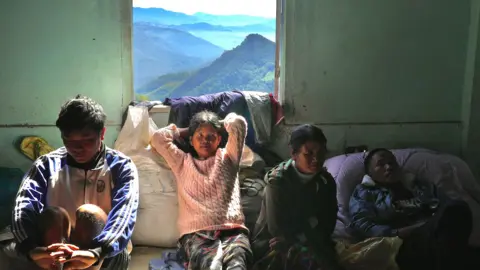
Four other women sitting around her start crying; the trauma of their flight is visibly evident. Iang fears not just for her safety from air strikes but also the prospect of being forced to participate in the elections. If we are caught and refuse to vote, they will put us in jail and torture us. We've run away so that we don't have to vote, she explains.
In recent weeks, the attacks have intensified, leading to an unprecedented level of fear among civilians, especially those from Chin State. Many have sought refuge in neighboring India, where local villagers provide basic survival supplies in rundown shelters, such as abandoned sports facilities.
Despite fleeing to safety, many displaced individuals describe the junta’s actions as the most brutal they've experienced since the coup took place back in February 2021. They recount stories of arrest, torture, and destruction at the hands of the military forces, which continue to dismiss claims of civilian suffering.
As the election approaches, marked by the absence of major opposition parties, residents express a collective sentiment of hopelessness, reflecting a desperate desire for genuine democratic representation instead of military rule. The National League for Democracy party, led by Aung San Suu Kyi, remains unable to contest the elections due to most of its leadership being detained.
In interviews with former residents of Chin State, many claimed that the elections, scheduled to take place over the next few weeks, are a facade intended to prolong military dictatorship. The junta's aggressive tactics have not deterred a significant portion of the population from resisting. Rebel groups within Chin State are mobilizing to counteract the offensive, while young civilians are increasingly drawn into the armed struggle against the military regime.
The grim reality faced by civilians caught in the crossfire illustrates the complexities of their struggle, highlighting both physical dangers and psychological traumas as they navigate life in a conflict-ridden region. As they anticipate the pending elections, hopes for peace and true democracy remain dim while the echoes of military aggression linger in their memories.}
Iang's face quivers as she recounts the story of what happened on 26 November in K-Haimual, her village in Myanmar's western Chin State, and then she breaks down. She's among thousands of civilians who've fled their homes in recent weeks after the Burmese military launched a fierce campaign of air strikes, and a ground offensive in rebel-held areas across the country, to recapture territory ahead of elections starting on 28 December.
Four other women sitting around her start crying; the trauma of their flight is visibly evident. Iang fears not just for her safety from air strikes but also the prospect of being forced to participate in the elections. If we are caught and refuse to vote, they will put us in jail and torture us. We've run away so that we don't have to vote, she explains.
In recent weeks, the attacks have intensified, leading to an unprecedented level of fear among civilians, especially those from Chin State. Many have sought refuge in neighboring India, where local villagers provide basic survival supplies in rundown shelters, such as abandoned sports facilities.
Despite fleeing to safety, many displaced individuals describe the junta’s actions as the most brutal they've experienced since the coup took place back in February 2021. They recount stories of arrest, torture, and destruction at the hands of the military forces, which continue to dismiss claims of civilian suffering.
As the election approaches, marked by the absence of major opposition parties, residents express a collective sentiment of hopelessness, reflecting a desperate desire for genuine democratic representation instead of military rule. The National League for Democracy party, led by Aung San Suu Kyi, remains unable to contest the elections due to most of its leadership being detained.
In interviews with former residents of Chin State, many claimed that the elections, scheduled to take place over the next few weeks, are a facade intended to prolong military dictatorship. The junta's aggressive tactics have not deterred a significant portion of the population from resisting. Rebel groups within Chin State are mobilizing to counteract the offensive, while young civilians are increasingly drawn into the armed struggle against the military regime.
The grim reality faced by civilians caught in the crossfire illustrates the complexities of their struggle, highlighting both physical dangers and psychological traumas as they navigate life in a conflict-ridden region. As they anticipate the pending elections, hopes for peace and true democracy remain dim while the echoes of military aggression linger in their memories.}