Staff at two leading Bangladeshi newspapers say they were gasping for air as protesters, roused by the death of a prominent activist, set their offices alight on Thursday.
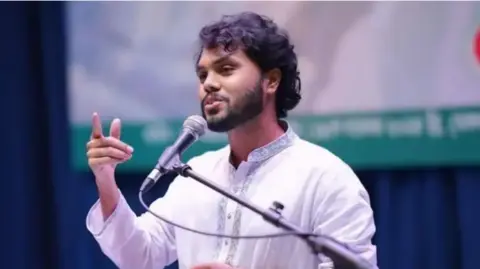
Sharif Osman Hadi, who had emerged as a key figure after last year's anti-government protests that ousted former prime minister Sheikh Hasina, was shot in Dhaka last week and died of his injuries on Thursday.
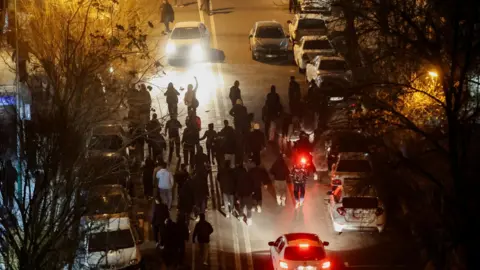
Hundreds of protesters stormed the offices of English newspaper The Daily Star and Bengali daily Prothom Alo on Thursday night, and the demonstrations extended into the next day.
It is one of the darkest days for independent journalism in Bangladesh, the English language Daily Star said in a statement.
For the first time in 35 years, The Daily Star could not publish its print edition on Friday and will be inoperable for a while, consulting editor Kamal Ahmed told the BBC.
Twenty-eight of our colleagues were trapped in the rooftop of the building for hours... They were gasping for fresh air, Ahmed said. They were rescued only after additional military reinforcement came.
No one has been seriously injured, but large parts of the buildings were completely charred when BBC Bangla visited on Friday. Smoke was still seen coming out of Prothom Alo's building.
The interim government led by Nobel laureate Muhammad Yunus condemned the violence, vowing to hand perpetrators full justice. Attacks on journalists are attacks on truth itself, it said in a statement on Friday.
The country is making a historic democratic transition, it said, which must not be derailed by those few who thrive on chaos and reject peace.
Bangladesh is scheduled to hold elections next February, the first since Hasina's ousting.
It is unclear why the hundreds of protesters targeted The Daily Star and Prothom Alo, which have long been regarded as secular and progressive. Because of that, they often came under fire during Hasina's administration.
However, since the July 2024 uprising, the two newspapers have maintained their critical stance on some of the interim government's policies, which may have angered supporters of Yunus' administration.
Other prominent buildings, including the home of the country's first president Sheikh Mujibur Rahman, who was Hasina's father, were also vandalized and set on fire on Thursday.
Hadi, 32, was a senior leader of the student protest group Inqilab Mancha and part of the youth movement that topped Hasina. He was also a vocal critic of neighbouring India, where Hasina remains in self-imposed exile.
Hadi had planned to contest in next February's election as an independent candidate, but was shot one day after authorities announced the date for the poll.
He was gunned down by masked attackers while leaving a mosque in Dhaka on 12 December. He succumbed to his injuries at a hospital in Singapore.
Yunus called Hadi's death an irreparable loss for the nation and claimed it was a premeditated attack by those conspiring to derail the election. The country's march toward democracy cannot be halted through fear, terror, or bloodshed, he said in a televised speech on Thursday.
The interim government has declared a day of national mourning on Saturday. Investigations are ongoing, and several people have been detained over the shooting.
Hasina fled to India in August 2004, following weeks of student-led protests, bringing an end to 15 years of increasingly authoritarian rule.
In November, she was sentenced to death for crimes against humanity after being found guilty of allowing lethal force to be used against protesters, 1,400 of whom died during the unrest.