In South Africa's remote Namaqualand region, home to a diverse variety of succulents, an illicit trade in these unique plants has surged, fueled by organized crime groups that capitalize on international demand. This biodiversity hotspot, while visually stunning, finds its ecological heritage increasingly threatened. "They've not just stolen our land or our plants, they've stolen our heritage as well," voiced a local livestock farmer, highlighting the distress caused to communities and ecosystems alike.
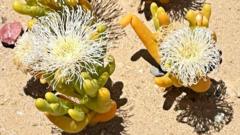
Many of the succulent species in question are endemic to the Succulent Karoo desert, which spans parts of South Africa and Namibia. These plants, known for their incredible ability to store water and thrive in arid conditions, range greatly in appearance—from tiny multi-colored buttons to larger, cactus-like varieties that burst into vibrant blooms. The allure of these succulents has led some to cultivate them in nurseries, but global demand has simultaneously fueled poaching, with these wild plants being smuggled to eager buyers in the US, Europe, and Asia.
In the small town of Kamieskroon, poaching activities have flourished amidst rolling hills that once served as a sanctuary for these species. Pieter van Wyk, a nursery curator at the /Ai /Ais-Richtersveld Transfrontier Park, warns that some highly localized species are disappearing due to overwhelming poaching pressures. With evidence showing that at least seven species have become extinct, conservationists express urgency in addressing this escalating crisis. The non-governmental organization Traffic reported that South Africa's law enforcement seized around 1.6 million illegally harvested succulents between 2019 and 2024, but the real numbers are likely much higher.
Recognizing the challenge, the South African government launched a strategy in 2022 aimed at combating poaching, which includes community educational programs focused on conservation. Amidst the Covid-19 pandemic lockdown, a marked increase in poaching occurred as international traders sought local collectors to supply the burgeoning demand for these wild succulents. Van Wyk noted a dangerous dynamic: "The syndicates saw this as an opportunity of making something viral… telling a wide as possible public: 'We have this super-strange looking thing that comes from the African continent.'"
This illegal activity poses greater dangers to local communities, with many individuals turning to poaching as a source of income in this economically disadvantaged region. As income rises, so do social issues, including substance abuse and community distrust, warns Malinda Gardiner from Conservation South Africa. She notes, “When they get the money, there's more drugs, more alcohol; children are neglected because mummy is drunk, daddy is drunk, there’s no food.”
Awareness efforts are underway to educate potential buyers about the importance of sourcing plants responsibly. A notable movement in China called the "Clean Internet for Conophytum" campaign has successfully reduced the online visibility of illegally sourced succulents by 80%, demonstrating the power of informed consumer choices.
Moreover, collaborative efforts are growing globally, as Traffic and the UK's Kew Gardens team up with platforms like eBay to develop strategies aimed at preventing the sale of wild succulents. Locally, Van Wyk insists on the potential for the legal cultivation of succulents to satisfy demand without jeopardizing wild populations. "We have this resource, and there are other countries that are majorly benefiting from this, why aren't we?" he questions.
Despite the strain, Van Wyk finds solace in nurturing succulents preserved through law enforcement efforts. “If you study these plants, it brings so much joy and pleasure, and you just forget about all the nonsense that’s happening in the world,” he reflects. The challenge to strike a balance between economic need and ecological preservation remains at the forefront as South Africa navigates this complex battle against illegal trade.