In brief
In its latest quarterly report, SEWA’s Electricity Distribution Department linked 898 projects across residential, commercial, industrial and service sectors in Sharjah city. The authority extended more than 99 km of medium‑ and low‑voltage lines, performed 1,119 inspections and approved 640 distribution boards, showcasing its commitment to expanding infrastructure with smart technologies. The effort positions Sharjah as a high‑standard, investment‑friendly environment.
The Sharjah Electricity, Water and Gas Authority (SEWA) announced that during the third quarter of 2026 its Electricity Distribution Department connected electricity to 898 projects across Sharjah city. The initiative involved extending more than 99 kilometres of medium‑ and low‑voltage networks, approving 640 electrical distribution boards, and conducting 1,119 technical inspections of buildings and projects.
Medium‑voltage supply—generally ranging from 1 kV to 35 kV—transports electricity over long distances with lower losses than high‑voltage transmission lines but before it reaches the consumer. Low‑voltage supply, typically below 1 kV, is the final stage that delivers power directly to homes, offices and factories. By expanding these two critical layers, SEWA improves distribution reliability and reduces voltage drops that can affect equipment performance.
According to the agency, the 898 projects spanned residential, commercial, industrial and service sectors, reflecting Sharjah’s rapid urban, industrial and commercial expansion. Connections were completed according to precise schedules and the highest standards of safety and environmental sustainability.
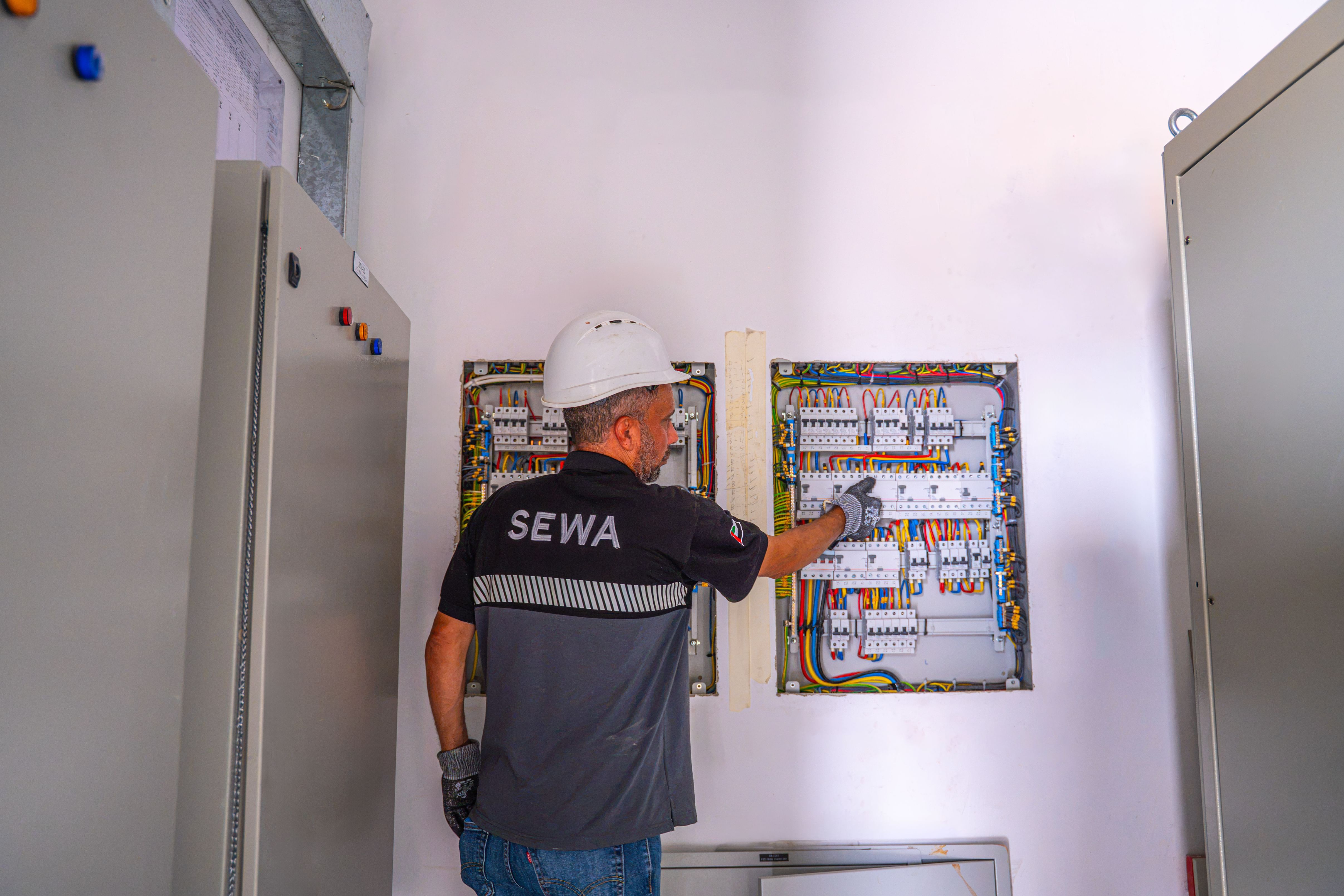
The Electricity Distribution Department also approved more than 640 distribution boards in line with pre‑approved technical specifications. Distribution boards, the electrical panels that split incoming power into circuits for different parts of a building or facility, play a pivotal role in ensuring that end‑users receive regulated voltage and current while protecting connected equipment from overcurrent and other faults.
Engineer Ahmed Al Bass, Deputy Director of SEWA’s Electricity Distribution Department, told WAM that these achievements were carried out “in accordance with the wise leadership’s directives … to provide citizens, residents and investors with services meeting international standards of quality and efficiency.” The official emphasized that the body was “pressing forward with its ongoing efforts to upgrade its networks and service facilities.”
SEWA also highlighted its use of smart technologies to improve service quality. Smart technologies, which can be defined as systems that integrate sensors, real‑time data analytics and automated control mechanisms, allow operators to detect faults quickly, balance loads dynamically and schedule maintenance proactively. By deploying such technologies, SEWA aims to guarantee rapid response times and boost operational efficiency.
During the quarter, SEWA’s Inspection and Certification Team performed 524 preliminary electrical inspection certificates. These certificates are required by the municipality before a project can obtain a final completion certificate. Through early certification, developers can demonstrate compliance with electrical safety regulations and reduce delays in obtaining municipal approval.
SEWA’s commitment to quality extends beyond technical specifications. The authority urged all customers and developers to strictly adhere to approved technical standards and specifications, ensuring seamless electricity connections that ultimately serve the best interests of the nation and the community. In line with this principle, the agency conducted a total of 1,119 technical inspections, reinforcing its role as a watchdog of safety and compliance across Sharjah.
The combined extension of 99 km of medium‑ and low‑voltage infrastructure represents a significant scaling effort, given that Sharjah’s population and industrial footprint continue to grow swiftly. By expanding its grid, SEWA is improving not only the immediate availability of power but also the robustness of the supply network against future demand spikes.
Moreover, the authority’s focus on smart control systems highlights an industry trend toward digital twins and predictive maintenance. Digital twins, highly detailed virtual models of physical assets, enable engineers to simulate conditions, forecast wear and predict component failures before they occur. In conjunction with predictive maintenance algorithms, such models can reduce downtime and extend the lifespan of critical infrastructure.
Although the agency’s report focused on the achievements of Q3 2026, it also alludes to continuous upgrades. SEWA is “pressing forward” with further enhancements to ensure that the bulk and distribution phases of the network meet modern reliability and efficiency benchmarks, such as reducing the voltage rise at the service entrance and improving fault clearance times.
By linking 898 new projects, extending 99 km of network, and approving 640 distribution boards, SEWA is underpinning Sharjah’s ambition to become a leading investment hub in the United Arab Emirates. The upgraded infrastructure, combined with the authority’s emphasis on safety, environmental sustainability and smart technologies, sets a benchmark for reliable, high‑quality service delivery across the region.