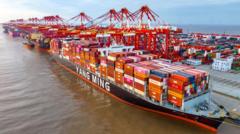
As Donald Trump re-enters the political arena, the potential resurgence of tariffs and isolationist policies casts a shadow over the global economy, with implications for inflation, trade dynamics, and growth forecasts.**Summary** With Donald Trump’s threats of new tariffs looming, experts warn of potential economic upheaval in 2025. As inflation rates rise globally and the U.S. opts for more isolationist policies, trade partners like China, Canada, and Mexico face significant challenges. With growth forecasts at a tepid 3.2%, the interconnected global economy must brace for instability. The economic outlook for 2025 is increasingly shaped by the anticipated return of more isolationist and tariff-driven policies under Donald Trump. This prospective "Trump 2.0" phase is raising eyebrows among economists, who predict that global trade dynamics could experience significant upheaval. The International Monetary Fund estimates growth will hold a modest 3.2%, reflecting a landscape riddled with challenges stemming from inflation, rising interest rates, and potential new tariffs on key trading partners.On the heels of a third consecutive interest rate cut in late 2024, the U.S. stock market experienced sharp declines. Federal Reserve chair Jerome Powell's caution towards further cuts indicates a need to tackle the persistent inflation that, although slightly slowing, remains above central banks' targets. Recent data showed inflation rates in November at 2.7% in the U.S., 2.2% in the Eurozone, and 2.6% in the UK, signaling an uphill battle for policymakers.Luis Oganes from JP Morgan highlights an essential concern for the global economy: uncertainty stemming from potential tariff implementation. Since Trump's recent electoral win, he has repeatedly threatened new trade barriers against major partners such as China, Canada, and Mexico. This shift could bolster short-term U.S. growth but threaten the economic health of nations dependent on trade with the U.S.Former IMF chief economist Maurice Obstfeld warns that tariffs, particularly those affecting the auto industry, could disrupt established supply chains across North America. This disruption may lead to increased prices, reduced demand, and ultimately, a slowdown in investment—all contributing to global recession risks.In China, where many factories thrive on exports, tariffs could exacerbate domestic issues. Despite growth forecasts ticking upward from 4.1% to 4.5%, China is caught in a bind as rising tariffs threaten to reduce external demand while it grapples with internal economic challenges.President Xi Jinping acknowledges "uncertainties" stemming from external factors, indicating a cautious approach to maintaining momentum in China's economy. Beijing's efforts to strengthen local markets and improve foreign investment flows are pivotal for long-term recovery, as firms seek alternatives to mitigate labor and production risks—notably, from the U.S.An emerging focal point in this renewed trade war is electric vehicles, where existing tariffs are already casting a pall over trade relations between the U.S., EU, and China. European Central Bank President Christine Lagarde underscored that such protectionist measures stifle growth and could further complicate the region's inflationary environment.While Germany and France face sluggish growth prospects amid political challenges, the pressure remains high on consumers and businesses to boost spending to offset potential downturns.As companies grapple with rising labor costs and inflation, experts argue that a dynamic, growing economy is critical for rejuvenating job markets and overall economic vitality. Should Trump’s administration unfold as anticipated with tax cuts and deregulation, the U.S. may maintain its economic momentum, albeit at a cost to global relations.In summary, the global economic landscape heading into 2025 is fraught with uncertainty as the potential impact of U.S. tariffs looms large, leaving trading partners wary and economic experts questioning the path to sustainable growth.
Title
The Economic Landscape Ahead: Unpacking the Impact of ‘Trump 2.0’ on Global Trade
Source: bbc.co.uk3 min read