
In brief
Georgians are mobilizing en masse, driven by frustration over government missteps and the looming threat of renewed ties with Russia, as opposition to the Georgian Dream party gains momentum.
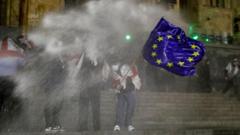
In the heart of Tbilisi, tens of thousands of Georgians have gathered nightly in a passionate display of defiance against their government, expressing their desire to align more closely with the West rather than succumb to the influence of neighboring Russia. Clad in the blue and gold of the European Union, as well as the red and white of the Georgian flag, protesters filled Rustaveli Avenue, demanding a future that embraces European values and democracy.The protests erupted after Georgian Dream, the ruling party, faced criticism for perceived authoritarianism. Although the party insists there are no ties to the Kremlin, its recent decisions have raised alarms regarding the country's pro-Western aspirations. The government has seen its partnership with the United States suspended, following escalating tensions with the European Union.In stark contrast to the government’s assertions, citizens have decried the political climate as increasingly oppressive, claiming that the recent elections were marred by fraud and irregularities. Protests turned violent as police deployed water cannons to disperse crowds, which have reported injuries on both sides. Eyewitness accounts paint a harrowing picture of police brutality, while the government's supporters argue that authorities face unwarranted aggression from protesters.Amid this chaos, a significant division is unfolding between the ruling party and opposition forces, who maintain that the government lacks legitimacy following the disputed election results. Prime Minister Irakli Kobakhidze remains firm, rejecting negotiation and claiming foreign funding for the protests, while opposition leaders like Nika Gvaramia insist that this is a fight for Georgia’s future against a potential resurgence of Russian dominance.With a severe backlash from citizens unwilling to recede back into Moscow's sphere of influence, sentiments against Russia have permeated the demonstrations, with cries of "No to Russia" and graffiti messages seen across the capital. Opposition activists are adamant that free and fair elections are crucial to restoring democracy.Exemplifying the political crisis is the fact that ambassadors, including Georgia's representative to the US, have resigned in protest against the government's direction. The continuous wave of protests does not appear to be waning, posing a significant test for the ruling party.Regardless of the outcome, Georgia stands at a pivotal crossroads. The ongoing unrest reflects a collective yearning among Georgians for democratic governance, while reaffirming their commitment to a European future — a sentiment that may well shape the nation’s identity for years to come.

