In brief
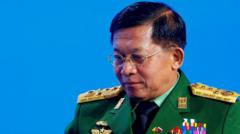
In a notable diplomatic event, Myanmar's military leader Min Aung Hlaing has embarked on his first visit to China since the country’s political upheaval in February 2021, which resulted in his regime ousting the elected government led by Aung San Suu Kyi. This trip is particularly significant as it reflects his isolated status following the coup, alongside the considerable military setbacks his regime has faced against various insurgent groups.
Min Aung Hlaing arrived in Kunming, Yunnan province, leading a large delegation of officials and business representatives for a minor summit of the Greater Mekong Sub-region. While this is not categorized as a state visit, it highlights China's continued interest in Myanmar and suggests that Beijing recognizes his role in addressing the ongoing conflict, despite his government's controversial track record since the coup.During the visit, Min Aung Hlaing is anticipated to meet with Chinese Premier Li Qiang, who will preside over the summit also attended by leaders from neighboring authoritarian regimes such as Laos, Cambodia, and Vietnam. Beijing has maintained a cautious but illustrative approach towards Min Aung Hlaing, especially following speculation that it might distance itself from him due to the escalating conflict and its repercussions along the border.The insurgency, particularly from ethnic groups along the border with China, has posed challenges not only for Myanmar but for Beijing as well. The offensive initiated against the Myanmar military, aiming to combat fraud operations harming Chinese citizens, has compelled China to shift its stance. Following this, Beijing has attempted to temper the insurgents to bolster the military regime's stability in Myanmar. China is believed to be pressuring Min Aung Hlaing to establish a roadmap for elections to restore order. They express concerns over safeguarding cross-border commerce and protecting Chinese investments. However, various groups opposed to the military junta have ruled out engaging with Min Aung Hlaing, advocating for a total overhaul of the military's influence in Myanmar's governance.In an official gathering, the spokesperson for the National Unity Government (NUG) representing the ousted administration expressed discontent with China's invitation to Min Aung Hlaing, arguing it risks sending a misleading signal to the populace. The NUG highlighted the need for stability and improvement in Myanmar, attributing the ongoing chaos to Min Aung Hlaing's actions.Nevertheless, the opposing factions remain far from dislodging the junta, provoking worries in China about the potential emergence of chaos should the military government collapse. Caught in a precarious situation, the situation in Myanmar leaves China as one of the few influential players capable of steering a resolution to the ongoing civil war—a role it appears willing to exercise even in light of the junta's contentious history. With Western influence minimal and neighboring India largely fixated on regional border issues, the onus of mediating the resolution in Myanmar seems to rest squarely on China's shoulders as it navigates its complex relationship with the troubled military regime.