In brief
Photographer Barry Webb showcases the hidden intricacies of slime mould through his macro photography, winning the people's choice award in the macro category at the British Photography Awards. Using advanced techniques, Webb captures the vibrant structures of these fascinating organisms, shedding light on their ecological significance and practical applications in urban mapping and scientific research.
Welcome to the world of slime mould.
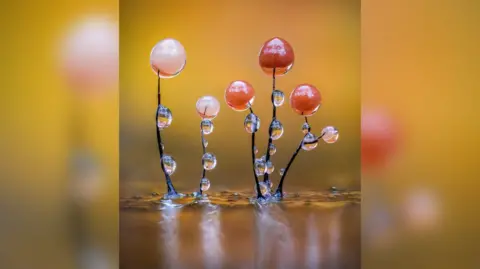
These images, captured by photographer Barry Webb, provide a close-up view of single-celled slime mould organisms that would not be possible with the naked eye.
Using a high-powered macro lens and a composite of stills, Barry reveals the tiny structures, which can thrive from forests to deserts.
The photographer, primarily based west of London, recently won the people's choice award in the macro section of the British Photography Awards.
Barry said he didn't know they existed before being introduced to slime mould in 2019. He spent more time outside photographing these organisms during the Covid lockdown.
His photography primarily focuses on the fruiting bodies of slime mould, revealing stunning colors and details during the spore release phase.
Barry explains that slime moulds feed off bacteria, algae, and fungi, playing a crucial role in the ecosystem. According to the RHS, slime mould has practical applications in tasks like urban transport mapping and even the search for dark matter.
Using a technique called focus bracketing, Barry overcomes the challenges of capturing these tiny organisms by taking over 100 photos to create a final image that showcases depth and detail.
With the advancement of technology, the focus adjustment process is now automated, making it easier for photographers to capture the mesmerizing beauty of nature's tiny, yet significant, organisms.