
In brief
Ukrainian forces used long‑range drones to hit a major oil terminal in St. Petersburg, a key revenue generator for Russia’s war machine, and also struck a naval base in Kronstadt. St. Petersburg governor reported a massive drone attack but no casualties, while Ukrainian President Zelensky highlighted the attack’s economic impact. The strike, part of a broader campaign against Russian energy infrastructure, demonstrates Ukraine’s increasing precision capabilities. Russia has yet to respond publicly, and the damage remains to be assessed. The incident underscores the escalating use of unmanned weapons in the ongoing conflict.
Ukraine has struck a major oil terminal in Russia’s second city of St. Petersburg and other targets in the country's north‑west.
In a post on social media, President Volodymyr Zelensky wrote: Ukraine's defence forces struck port oil infrastructure that generates revenue for Russia's war. He also said an important military target was hit overnight in Kronstadt, a nearby naval base.
St. Petersburg Governor Aleksandr Beglov said the city was under a massive drone attack and acknowledged the oil terminal was hit. He reported no casualties.
Ukraine has intensified its long‑range drone attacks on Russian energy infrastructure over recent months, causing fuel shortages in a number of regions.
Zelensky noted that the St. Petersburg and surrounding targets were about 850 km (528 miles) from Ukraine's border.
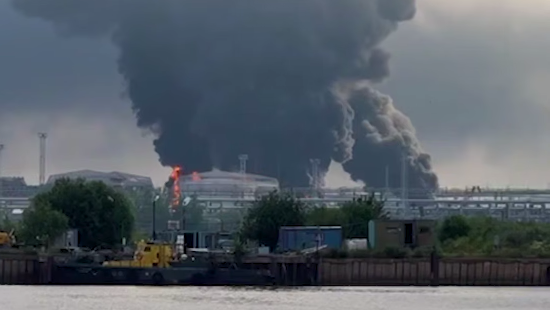
The extent of the damage was not immediately clear, but a video from the Ukrainian president showed a drone approaching a target and a huge column of black smoke billowing from the area after the strike.
BBC later confirmed that St. Petersburg's oil terminal was hit. Ukraine's military described the terminal as one of the largest in Russia, capable of producing 12.5 million tonnes of petroleum products per year.
The military also said a key naval base of Russia's Baltic Fleet in Kronstadt was hit. Russia has not publicly commented on the claim.
On Telegram, Governor Beglov said that 72 Ukrainian drones were shot down over St. Petersburg and the wider Leningrad region. He urged residents to stay indoors until the drone threat lifted, warning that mobile internet services could be disrupted.
More than five million people live in St. Petersburg.
In a separate development on Saturday, Ukraine's military denied that the key eastern Ukrainian town of Kostyantynivka was under full Russian control. Military spokesman Maj Andriy Kovalyov told BBC the town remains under Ukrainian defence forces, though infiltration by small infantry groups deep into Ukraine's formations has been noted and countered.
Putin had claimed that Russian control had been established over Kostyantynivka in June, but he offered no evidence to support this claim.
Zelensky wrote on Telegram: If Kostyantynivka is now under Russian control, then Putin will probably have no problem meeting me there and finding diplomatic solutions to finally end the war. But still, he will not cross the front line: the truth is very different from Putin's words.
Kostyantynivka is part of Ukraine's 'fortress belt' in Donetsk, most of which is occupied by Russia. Putin launched a full‑scale invasion of Ukraine in February 2022, and Moscow currently controls about 20% of Ukrainian territory.


