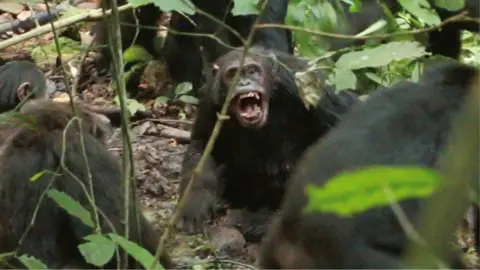
The world's largest known group of wild chimpanzees has split and been locked in a vicious 'civil war' for the last eight years, according to researchers.
It is not clear exactly why the once close-knit community of Ngogo chimpanzees at Uganda's Kibale National Park are at loggerheads, but since 2018 the scientists have recorded 24 killings, including 17 infants.
These were chimps that would hold hands, lead author Aaron Sandel said. Now they're trying to kill each other. The study, published in the journal Science, suggests the intensity and duration of the violence may inform how early human conflict may have developed.
Sandel, an anthropologist from the University of Texas in the US, and co-director of the Ngogo Chimpanzee Project, says chimpanzees are 'very territorial', having 'hostile interactions with those from other groups'.
Over several decades, the nearly 200 Ngogo chimpanzees had lived in harmony, divided into two sets known to researchers as Western and Central, coexisting as a cohesive group.
The violence first emerged after a 2015 dispute led to a prolonged period of avoidance between the two groups, resulting in more intense and aggressive interactions.
Since the split in 2018, attacks have increased, with specific assaults resulting in numerous casualties among the Central group. Factors contributing to this conflict include the group size, competition for resources, and changes in social structure.
The researchers identified three key catalysts for this shift: the unexplained deaths of several adults in 2014 disrupting social networks, a change in the alpha male coinciding with increased aggression, and a respiratory epidemic that decimated group members a year prior to the separation.
The findings could challenge traditional notions of human conflict by suggesting that relational dynamics may be fundamental to understanding both chimpanzee and human warfare, emphasizing the need to learn from the behavioural patterns observed in other species.