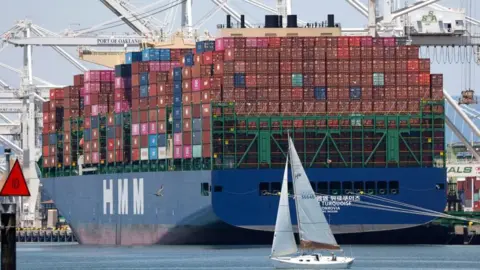
The US has seized a sixth tanker in the Caribbean Sea in its ongoing efforts to control exports of Venezuelan oil, officials say.
The vessel, Veronica, was boarded in a predawn operation 'without incident' as it was defying President Donald Trump's 'quarantine of sanctioned vessels', said the US military.
'The only oil leaving Venezuela will be oil that is coordinated properly and lawfully,' the Southern Command said.
Since the US military strikes on Venezuela and seizure of its president Nicolás Maduro this month, Trump has said he plans to tap into the country's huge oil reserves.
'The Veronica is the latest tanker operating in defiance of President Trump's established quarantine of sanctioned vessels in the Caribbean,' US Southern Command said in a post on social media.
It also posted a video showing Marines and sailors boarding the tanker.
Veronica, a crude oil tanker sailing under a Guyanese flag, departed empty from Venezuelan waters in early January, according to monitoring service TankerTrackers.com.
The International Maritime Organization's database shows the vessel was previously registered in Russia under different names.
Homeland Security Secretary Kristi Noem posted on social media that Thursday's tanker seizure was carried out with 'close coordination with our colleagues' in the military as well as the state and justice departments.
'Our heroic Coast Guard men and women once again ensured a flawlessly executed operation, in accordance with international law,' Noem added.
This suggests Washington's crackdown on the so-called dark fleet, comprising more than 1,000 vessels that transport sanctioned oil, will continue as the US works with Venezuela's interim government to control the country's oil sales.
It also comes a day after an American official said the US had completed its first sale of Venezuelan oil, valued at $500m (£373m).
Trump last week asked oil executives at the White House to invest $100bn in Venezuela's energy infrastructure. They indicated that significant changes would be needed to make the country an attractive investment.
The blockade has sharply curtailed Venezuelan oil exports, with only ships associated with Chevron and bound for the US operating as usual, according to Matt Smith, head of US analysis at Kpler.
Loadings have fallen roughly in half this month to about 400,000 barrels per day, he said.
The Veronica, a relatively small tanker with a sanctioned owner, was among about 17 ships that attempted to breach the blockade earlier this month, according to the firm.
Smith noted that it was unclear why vessels from the so-called dark fleet would risk seizure but mentioned that the financial cost of delays could be significant, stating, 'If a tanker was supposed to be moving crude and can't get through, that's money lost.'
He also remarked that the US quarantine had created a bottleneck of supply that would otherwise be headed to countries, mainly China.
However, as the US begins selling Venezuelan oil, there are indications that the situation is evolving, with some tankers now directed towards the Bahamas for storage.
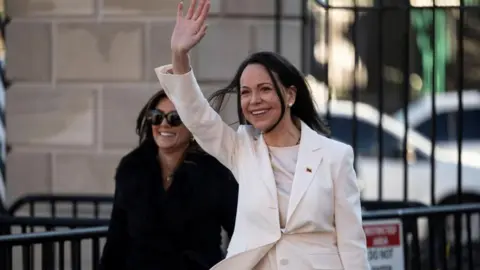
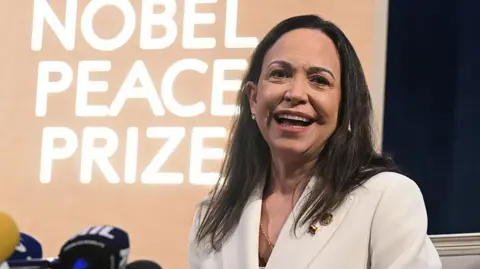
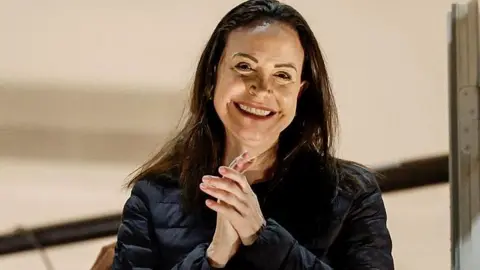
The latest tanker seizure occurred just hours ahead of a meeting between Trump and Venezuela's opposition leader Maria Corina Machado at the White House.
Trump has previously described her as a 'freedom fighter', but rejected the idea of appointing her to lead Venezuela after Maduro's exit, arguing she lacks sufficient domestic support. Instead, he has favored Delcy Rodríguez, Maduro's former vice-president.
Machado is expected to use her meeting with Trump to persuade him that backing Rodríguez's interim government is a misstep and that her opposition coalition should lead the transition.
A Venezuelan government envoy is also anticipated to visit Washington to meet US officials and facilitate the reopening of the Venezuelan embassy, according to reports.
This emissary is said to be a close ally of interim president Delcy Rodríguez, who has reportedly been 'extremely cooperative' with the US government.
On Thursday, White House press secretary Karoline Leavitt stated that the $500m energy agreement was significantly aided by Rodríguez's cooperation.
Leavitt added that Venezuela had agreed to release political prisoners, with five Americans released in the same week.
'The president likes what he's seeing. And we'll expect that cooperation to continue.'