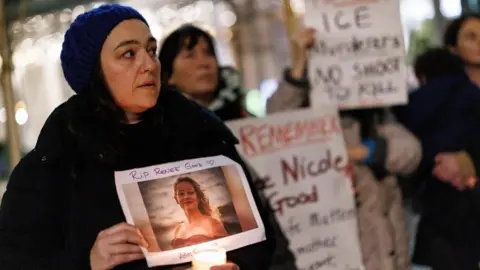
The investigation into the shooting death of Renee Good by a U.S. Immigration and Customs Enforcement (ICE) agent in Minneapolis has opened a complex dialogue around the justification of deadly force and the impact of political discourse on investigative integrity.
Following the shooting of Good, 37, multiple narratives have emerged. President Donald Trump labeled her actions as those of a domestic terrorist who attempted to run over agent Jonathan Ross; contrastingly, local officials described her as a mother trying to escape the scene.
Videos of the incident show Ross firing at Good while she was in her car. This footage has been scrutinized from both sides, with federal officials insisting it demonstrates that Good posed a threat, while state officials interpret it to mean the opposite. According to former law enforcement professionals, such conflicting interpretations complicate any independent assessment of the circumstances surrounding the shooting.
Former FBI agent Robert D'Amico noted that the public's judgment, influenced by political figures who have declared the shooting justified prior to the investigation's conclusion, could create challenges for a fair evaluation. You have problems when statements come from those in command before the facts are in, he stated.
Moreover, to assess the shooting in accordance with the Department of Homeland Security's (DHS) guidelines, investigators must consider Ross's perception of imminent danger against the backdrop of his previous experiences with threats during his duties. The standards set by DHS govern the use of deadly force—permitting it only when an officer believes their life is at risk and when no reasonable means of avoidance exists.
While the federal inquiry is ongoing, Minnesota officials have expressed concerns about potential biases, prompting their own investigation into the matter. Governor Tim Walz emphasized the importance of maintaining the integrity of the inquiry, where both local and federal narratives intersect amidst the political atmosphere surrounding the event.
The culmination of evidence will extend beyond video footage, encompassing witness accounts and thorough scene reconstruction, to ensure a comprehensive assessment is achieved. Yet with growing national scrutiny and protests in response to the controversial shooting, the outcome remains tenuous as investigators navigate the politically charged space surrounding this tragic event.