Residents in Thailand's Ban Thanon Khot are accustomed to the rumbling of trains – rail is a key mode of transportation connecting the remote town with major cities.
But on Wednesday, the mundane rhythm ended in tragedy.
The noise was abnormally loud. A huge, crashing sound, said school volunteer Pitchaya Promenade. I saw a blue crane sliding. It seemed stuck for a moment, and suddenly it flipped over.
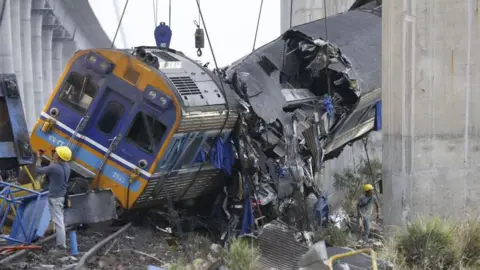
The construction crane had collapsed onto a moving train, killing at least 32 people and injuring 66 others. Most were students and workers travelling for school and work.
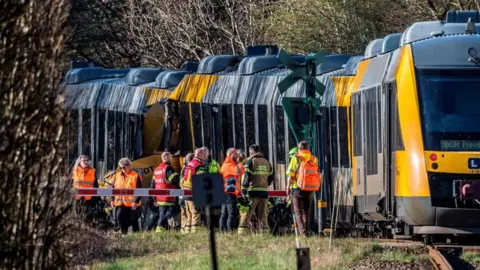
The BBC arrived at a grim scene in the evening, with rescuers still pulling bodies out of the mangled train. Parts of it were completely crushed.
One witness noted the damage, saying it looked like a spoon scooping into a slice of cake. Many described the chaotic scene as passengers screamed for help amidst the smoke and debris.
Emergency responders used cranes and hydraulic tools to free those trapped. Among the victims, a one-year-old child and an 85-year-old were both injured, highlighting the tragic range of affected individuals.
Local residents are questioning the safety standards at play, as the crane was part of a $5.4 billion China-backed overhead railway project. Authorities have initiated investigations and the construction firm involved may face legal action after a history of safety concerns.
Natural causes can almost entirely be ruled out as the origin of the incident, said an engineering professor, emphasizing the role of human error in the disaster.
This incident adds to a troubling history of construction accidents in Thailand, sparking renewed calls for stringent safety regulations.