In brief
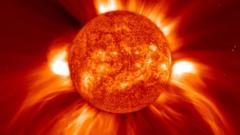
In a significant advancement, Indian scientists have reported major findings from the Aditya-L1 solar mission, revealing critical data about solar events that could have global implications. On July 16, the mission's Visible Emission Line Coronagraph (Velc) successfully captured a coronal mass ejection (CME) and helped scientists estimate the precise onset time of this solar phenomenon. CMEs are large explosions of plasma and magnetic field from the Sun’s corona that can impact satellite operations, communications, and even power grids on Earth.
The recent CME studied by Aditya-L1 originated at approximately 13:08 GMT but was soon deflected away from Earth, avoiding any detrimental effects on terrestrial weather. Research led by Prof. R Ramesh from the Indian Institute of Astrophysics emphasizes the importance of monitoring these solar phenomena, as CMEs can reach speeds up to 3,000 km/s and possess an energy mass of up to a trillion kilograms. When they travel towards Earth, they can create serious disruptions in space weather and affect satellite electronics, leading to potential chaos in communications both on the ground and in space.Solar storms are not entirely benign; although they might create stunning auroras, they have historically disrupted power grids and communication systems. One of the most devastating examples was the 1989 event where a CME knocked out Quebec’s power grid. The research from Aditya-L1 pushes forward our understanding of solar forecasting—a crucial element for preventing large-scale disruptions caused by solar activity.Aditya-L1, which stands for "Sun" in Hindu mythology, joins an elite group of missions observing the Sun from space, alongside efforts from NASA, ESA, and others. Its advantage lies in its capacity to provide an uninterrupted view of the solar corona, particularly effective in detecting CMEs even during periods of eclipses.With a combination of both space-based initiatives and ground observatories, Indian scientists aim to deepen our comprehension of solar activity, promising improved safety and preparedness against potential solar-driven disruptions globally.The research not only positions India at the forefront of solar studies but also contributes to the broader understanding of our solar system's dynamics, reinforcing the need for collaborative international efforts in space research and disaster preparedness.