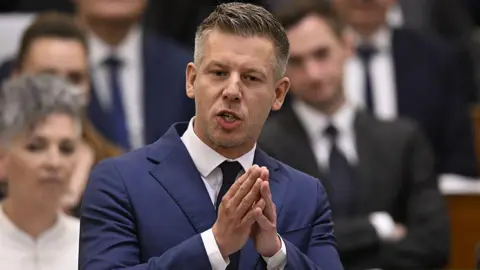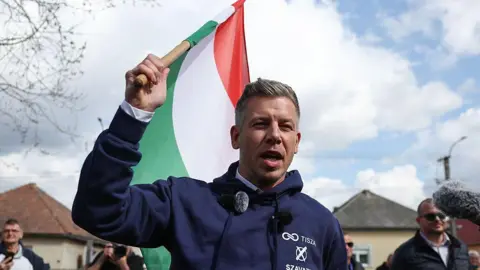
Now or never, Peter Magyar has been telling Hungarians, in a breathless campaign across the country in the run-up to 12 April elections that opinion polls suggest he can win. This 45-year-old former Fidesz party insider represents the biggest threat to Viktor Orban's rule in Hungary since he won the first of four consecutive victories in 2010. Magyar's slogan dates back to a revolutionary poet's 19th Century rallying cry to rise up for the homeland. After more than 100 campaign stops, his message has been shortened to Now: the words or never have been crossed out, adding to the urgency.
He is on course to visit all of Hungary's 106 constituencies and has given four, five, even six speeches a day. Magyar has built a powerful support base in more than two years of touring the country, even in the small towns and villages where Fidesz traditionally dominates. Last year he walked 300km (185 miles) from Budapest to the Romanian border in a campaign to reunite the nation, in a bid to bring natural Fidesz voters to his side. Magyar promises to tackle corruption, improve the economy, and he has sought to woo Hungary's disadvantaged Roma community. He has also promised to unlock billions of euros in EU funds, frozen largely because of concerns over Hungary's rule of law.
But Orban has depicted him as a puppet of the EU and Ukraine, and he has been wary of getting too close to Brussels and promised voters we are the real party of peace. Magyar's self-confidence stems from a deep understanding of the rival he faces. Until February 2024, he was very much part of the Fidesz family, having joined the party at university and married one of its rising stars, Judit Varga, with whom he had three children.
Magyar stunned Hungarians with a live appearance on a pro-opposition YouTube Channel called Partizán. In a country of 9.6 million people, a million watched as a solemn Peter Magyar explained why he had had enough of his own party. The current opposition was deemed inept, and Magyar expressed hope for political change despite the challenges Orban's government posed.
By now Magyar has taken strides politically, forming a new party named Tisza and addressing various social concerns and corruption allegations by the Orban regime. While Orban remains a dominant force, Magyar's relentless campaign and new party formation signal a significant shift in Hungary's political landscape, positioning him as a formidable opponent as elections loom.
He is on course to visit all of Hungary's 106 constituencies and has given four, five, even six speeches a day. Magyar has built a powerful support base in more than two years of touring the country, even in the small towns and villages where Fidesz traditionally dominates. Last year he walked 300km (185 miles) from Budapest to the Romanian border in a campaign to reunite the nation, in a bid to bring natural Fidesz voters to his side. Magyar promises to tackle corruption, improve the economy, and he has sought to woo Hungary's disadvantaged Roma community. He has also promised to unlock billions of euros in EU funds, frozen largely because of concerns over Hungary's rule of law.
But Orban has depicted him as a puppet of the EU and Ukraine, and he has been wary of getting too close to Brussels and promised voters we are the real party of peace. Magyar's self-confidence stems from a deep understanding of the rival he faces. Until February 2024, he was very much part of the Fidesz family, having joined the party at university and married one of its rising stars, Judit Varga, with whom he had three children.
Magyar stunned Hungarians with a live appearance on a pro-opposition YouTube Channel called Partizán. In a country of 9.6 million people, a million watched as a solemn Peter Magyar explained why he had had enough of his own party. The current opposition was deemed inept, and Magyar expressed hope for political change despite the challenges Orban's government posed.
By now Magyar has taken strides politically, forming a new party named Tisza and addressing various social concerns and corruption allegations by the Orban regime. While Orban remains a dominant force, Magyar's relentless campaign and new party formation signal a significant shift in Hungary's political landscape, positioning him as a formidable opponent as elections loom.