In brief
The recent launch of Shenzhou 19 marks a significant step for China’s space program, showcasing youthful energy and ambitions aimed at asserting its presence on the Moon and in space exploration.
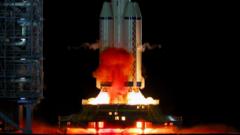
China's space aspirations came to life once more as the ground shook and flames illuminated the Gobi Desert during the launch of the Shenzhou 19 spacecraft. This mission is notable not merely for its technical achievements, but for its three crew members—China's youngest-ever taikonauts—who will spend the next six months at the Tiangong space station, conducting experiments and preparing for future lunar missions. Inside the Jiuquan Satellite Launch Center in Gansu, excitement radiated from the crowd as taikonauts Wang Haoze, Song Lingdong, and Cai Xuzhe prepared for liftoff, heralded as a moment of national pride. This youthful crew, particularly significant as they include the nation's first female space engineer, symbolizes a new era for China’s space endeavors, which President Xi Jinping deems pivotal in the nation’s quest to assert its position in the cosmos.With ambitions of establishing a presence on the Moon by 2030, China's actions have drawn both admiration and concern internationally. NASA chief Bill Nelson remarked on the competitive nature of space exploration, as the US perceives China's advancements as a potential military threat. This sentiment is echoed by military leaders in the US who fear that China’s rapid development of satellite technology could be used for surveillance and strategic purposes.In contrast to American skepticism, Chinese officials maintain that their objectives focus on peaceful exploration and pioneering advancements, with hopes to engage in future international collaborations. “We aim to uphold the peaceful use of space,” stated Li Yingliang from China's Manned Space Agency, emphasizing the collective benefit of humanity’s ventures into outer space.However, the Moon holds tantalizing resources, and competition over those assets complicates the dialogue. With estimates of lunar minerals potentially worth trillions, the quest for dominance by both the US and China could redefine global territorial claims beyond our planet. At the launch center, experts are optimistic about research benefits, such as studying microgravity's effects, which have the potential to yield medical breakthroughs applicable back on Earth. With future missions anticipated to include more space endeavors, including research facilities on the Moon and Venus atmospheric missions, the challenges of meeting escalating technological demands persist.While there’s palpable enthusiasm for the space program domestically, caution permeates their approach. Security measures around journalists illustrate a desire to protect sensitive advancements at all costs. The tense atmosphere signals the reality that future territorial claims in space will be as contested as those on Earth, marking an uncertain chapter in human exploration. As preparations for subsequent missions continue, China’s resolve to carry its banner into the cosmos shines ever brighter, showcasing an emerging narrative of youth and ambition. The stage is set for the new space race, with much at stake for the future of not only the two nations but for all humanity.