In brief
As the Syrian Identification Centre begins the painstaking process of identifying the victims in mass graves, families continue to seek closure from the horrors of a decade-long conflict under former leader Bashar al-Assad. The efforts face numerous challenges, including lack of resources and the haunting memories of those who disappeared.
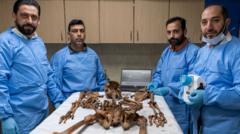
In a newly opened facility in Damascus, efforts are underway to sift through bones recovered from mixed mass graves in Syria, a testament to the atrocities of the 13-year civil war. Dr. Anas al-Hourani, head of the Syrian Identification Centre, surveys tables lined with femurs, noting that these remains likely belonged to the countless victims of the Assad regime, exterminated in recent months. Years of bloodshed under the dictatorship of Bashar al-Assad and his father, Hafez, led to the brutal deaths of hundreds of thousands, with many others still unaccounted for. As the task of identifying skeletal remains begins, Dr. al-Hourani highlights the limitations faced by the center. While forensic identification can unlock invaluable information about victims, including height, age, and potential torture marks, the ultimate goal remains DNA analysis. However, the sole DNA lab in Syria is heavily restricted by international sanctions, hampering efforts with limited resources.Funding from the International Committee of the Red Cross sustains this grim endeavor, with the reality that identifying victims from mixed mass graves can take years due to logistical and financial constraints. Many families of the disappeared express frustration over insufficient acknowledgment of their plight by the newly established government of Islamist rebels.Amidst the challenging environment, the discovery of eleven such mixed mass graves has surfaced around an isolated hillside outside Damascus, now sunken into the ground. Accompanied by former military driver Abu Ali, who carried out the harrowing task of discarding corpses, the BBC uncovered stark truths about the somber reality of the regime's actions. Abu Ali describes loading bodies like cargo, the sight of mangled human remains embedded in his memory. Elsewhere in the city, Malak Aoude mourns the loss of her sons, forcibly disappeared during the conflict. The uncertainty of their fates hangs over her, as she searches for any trace of her boys. The fragments of experiences shared by witnesses assert that her sons may have perished in detention, urging her to keep seeking answers even in a transformed Syria. Despite their fractured hopes following Assad’s fall from power, many families remain in limbo, unsure of what closure looks like amidst stories filled with violence and despair. After years of conflict, the struggle for truth, justice, and healing in Syria is only just beginning, foreshadowing a laborious path ahead for the identification of the fallen.