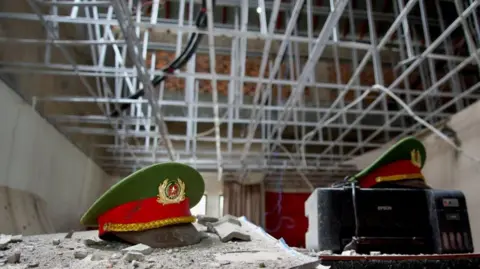
Wandering down the unlit corridors of a six-storey building behind the Royal Hill casino, each door opens onto a different world. In one there is a perfect replica of a Vietnamese bank. In another, you're in an Australian police station. A Chinese police officer's shirt hangs in one corner. Motivational messages have been painted on the walls: Money Coming From Everywhere reads a sign in Chinese, while discarded fake hundred dollar bills litter the floor.
This was a massive scam compound, just inside Cambodia in O Smach, where thousands of individuals worked under a harsh regime to defraud countless victims globally. After a bombing raid by the Thai air force, which claimed the Royal Hill was being used for launching drones during a brief border conflict, the workers fled, abandoning meals and personal items amidst the chaos.
The site now stands empty, except for Thai soldiers who occupy the area. Police recently indicated that over 10,000 foreign workers have been repatriated, revealing the grim conditions they faced. Despite the government's declared intention to eradicate scam operations, skepticism remains as to whether real change will occur or if the industry will simply relocate and persist under different guises.
Many details surrounding the Royal Hill Casino's operation came to light only after it was taken under Thai control. Documents revealing the required punishments for employees failing to meet quotas, such as beaten for underperformance, were discovered. Workers were coerced into committing scams against vulnerable individuals, often under conditions they had not anticipated when initially hired.
This situation underscores the complexities involved as the Cambodian government navigates both domestic and international pressures regarding human trafficking and fraud. The fallout and continuing implications of these operations on both a local and global scale are still unfolding.
This was a massive scam compound, just inside Cambodia in O Smach, where thousands of individuals worked under a harsh regime to defraud countless victims globally. After a bombing raid by the Thai air force, which claimed the Royal Hill was being used for launching drones during a brief border conflict, the workers fled, abandoning meals and personal items amidst the chaos.
The site now stands empty, except for Thai soldiers who occupy the area. Police recently indicated that over 10,000 foreign workers have been repatriated, revealing the grim conditions they faced. Despite the government's declared intention to eradicate scam operations, skepticism remains as to whether real change will occur or if the industry will simply relocate and persist under different guises.
Many details surrounding the Royal Hill Casino's operation came to light only after it was taken under Thai control. Documents revealing the required punishments for employees failing to meet quotas, such as beaten for underperformance, were discovered. Workers were coerced into committing scams against vulnerable individuals, often under conditions they had not anticipated when initially hired.
This situation underscores the complexities involved as the Cambodian government navigates both domestic and international pressures regarding human trafficking and fraud. The fallout and continuing implications of these operations on both a local and global scale are still unfolding.