
In brief
A recent 5.3 magnitude earthquake struck Santorini amidst ongoing seismic activity that has seen thousands of tremors reported since January. While no injuries or significant damage have emerged, experts caution that the possibility of a major quake remains, prompting heightened vigilance among locals and ongoing impacts on tourism.
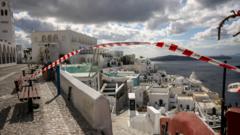
The renowned Greek island of Santorini has been struck by a powerful earthquake measuring 5.3 on the Richter scale, marking the most substantial seismic event in a recent spate of activity that has rattled the region. This latest quake, occurring at a depth of 17 kilometers, reverberated through nearby Athens on Monday evening and follows a notable 5.0 magnitude quake that transpired between the islands the previous day. Since the onset of seismic disturbances in January, more than 12,800 earthquakes have been recorded by the University of Athens' Seismological Laboratory, raising concerns among residents and local authorities. Many have taken to patrolling cliffs to prevent tourists from capturing potentially dangerous photographs, as landslides have been reported in various areas of Santorini due to the frequency of the tremors.While initial optimism from seismologists suggested a possible subsiding of the quake's intensity, experts are now expressing concern about a potential escalation. A state of emergency is in effect for Santorini and will remain in place at least until March 3. In the wake of these events, schools have been closed across Santorini, Amorgos, and nearby islands. The exceptional seismic activity has resulted in the evacuation of over 11,000 people from the islands, with damage assessments showing no significant harm to structures or casualties reported thus far. Authorities have dispatched a team from the Special Disaster Response Unit to Amorgos to assess the situation and maintain safety measures.Kostas Papazachos, a seismologist at the Aristotle University of Thessaloniki, remarked on the essential need for patience as the tremors persist, stating, "Let's hope that we will slowly move towards a gradual de-escalation." He further emphasized that the potential for a larger major earthquake has not been ruled out.Amidst this turmoil, the cruise ship Viking Star has altered its route to dock at Crete, bypassing Santorini due to concerns about the stability and safety during this seismic crisis. Greece remains one of Europe’s most seismically active regions. Despite the intensity of recent quakes, scientists remain perplexed by the clustering of the tremors, which have not coincided with a significant geological event. While Santorini is part of the Hellenic Volcanic Arc, no volcanic activity has been officially linked to these earthquakes, which are believed to stem from tectonic plate movements.

