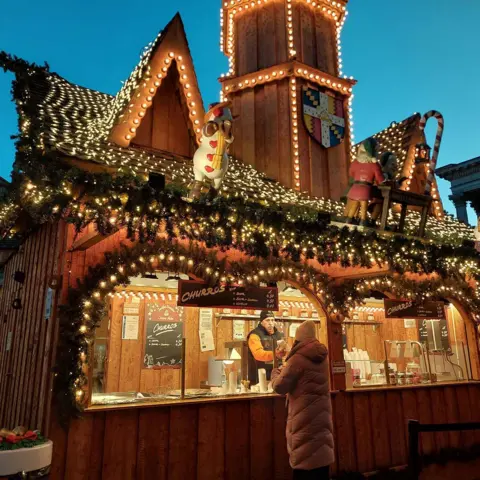
Wooden huts are glittering with golden fairy lights as groups of friends gather in woolly hats, warming their hands on mugs of mulled wine.
Signs written in German are dotted about - Glühwein (mulled wine), Bratwurst (grilled sausage), Kinderpunsch (non-alcoholic punch).
This isn't Germany - it's Birmingham's Frankfurt Christmas Market, organised as 'the largest authentic German Christmas market' outside the country and Austria.
Christmas markets are thought to have originated in Germany in the 14th Century. BBC News visited some to provide inspiration for your next festive visit, examining how close UK markets are to that traditional ideal.
A taste of Germany... in Birmingham?
On a cold Thursday afternoon in Birmingham, we meet Nina Adler and Till Rampe, German students pursuing PhDs in the UK's 'second city'. As we walk around the market, which snakes through streets close to Birmingham New Street railway station, they're reminded of home.
They note the wooden huts, food, and handicrafts as clear signs of authenticity. The chocolate-coated marshmallows impress Till, who is from near Frankfurt. 'I could swear they are from my hometown,' he says.
However, not everything matches the German experience. Nina, from Berlin, expresses that 'people are just connecting Germany with beer', pointing out that mulled wine is usually more common there. The pop tunes blasting in Birmingham, like 'The Power of Love', could distract from the typical festive spirit you'd find in a German market, focused on traditional music and carols.
Yet the market's setup speaks volumes. Organised by Kurt Stroscher, who also directs Frankfurt's Christmas market, it uses only wooden stalls and atmospheric white lights, with food and drink imported directly from Germany.
The visit to Birmingham's market yields mostly positive remarks on authenticity, but how does it stack up against those in Germany?
Contrasting Experiences
In Berlin, Christmas markets are deeply ingrained in holiday culture, marking a significant communal experience. Opening on November 24, locals populate markets with the smell of roasted almonds and mulled wine filling the air.
Several features define the traditional German Christmas market: large tents, handmade crafts, and, of course, traditional foods. The atmosphere is characterized by colorful lights and a sense of community, differing in feel from some markets found in the UK.
Even as UK markets evolve—often embracing broader culinary influences—the essence of the traditional German Christmas market remains anchored in its unique cultural heritage. Birmingham's market, with its dedication to authenticity, stands as a noteworthy model amid a landscape of changing festive markets across the UK.