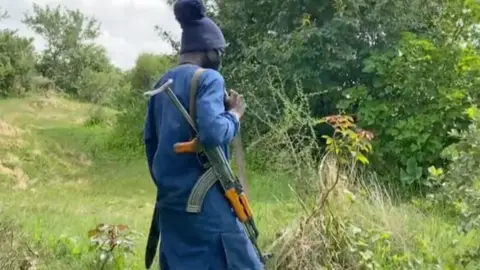
Nigeria is currently grappling with a spate of mass abductions. But the vast country - bigger than France and Germany combined - also faces many other security challenges.
Recent attempts to frame the insecurity purely as the persecution of Christians overlook the complexity of Africa's most populated nation. There are more than 250 ethnic groups in Nigeria, which is roughly divided into a mainly Muslim north and a largely Christian south, with intermingling in the middle. The government reports that people of all faiths have been victims of attacks.
The challenges include criminal gangs in the north-west, an Islamist insurgency in the north-east, clashes over land in the central regions, and separatist unrest in the south-east. The 400,000-strong army and the police force of 370,000 officers are overwhelmed.
Here's a breakdown of the main armed groups and flashpoints:
'Bandits' - Kidnap Gangs
Known locally as bandits, these criminal gangs largely consist of individuals from the Fulani ethnic group, who traditionally raised livestock. Their shift to crime is largely attributed to the proliferation of assault rifles since Libya's instability began. Motivated by profit rather than ideology, these groups employ kidnapping for ransom as a lucrative alternative to their traditional livelihoods.
Mobile and quick to strike, they often operate in family-based units with little central organization. The Nigerian government has designated these bandits as terrorists, with notable leaders under police pursuit.
Boko Haram - Jihadist Group
This Islamist militant group is infamous for the 2014 kidnapping of over 200 schoolgirls from Chibok, many of whom remain missing. Founded in 2002, Boko Haram has since evolved and splintered, continuing to orchestrate attacks on civilians and declaring war on security forces.
Despite internal conflicts weakening their operational capacity, the group remains a potent threat, often targeting educational institutions and places of worship.
Iswap - Boko Haram Splinter Group
Emerging from Boko Haram's ranks, Iswap has made headlines for its strategic targeting of military and government personnel while avoiding civilian casualties.
Actions from attacks and turf wars against Boko Haram highlight the complex nature of the extremist landscape.
Ansaru & Mahmuda - Jihadist Offshoots
These Boko Haram splinters have diversified their tactics, engaging in kidnappings and targeting law enforcement and civilians across various states.
Herders vs Farmers - Resource Conflicts
This long-standing conflict centers on grazing rights between nomadic Fulani herders and sedentary farmers, which has been exacerbated by urban encroachment on traditional grazing routes.
The competition for land and water has resulted in retaliatory violence and the proliferation of armed groups among both factions.
Ipob - Separatist Group
Rooted in the desire for Biafran independence, the Indigenous People of Biafra (Ipob) strives for self-determination and has reportedly resorted to violent measures, leading to economic strain due to enforced stay-at-home orders.
The current situation in Nigeria reflects a confluence of various forces that perpetuate violence and insecurity, complicating efforts for peace and stability across the nation.