The European Parliament has suspended the approval of a key US trade deal agreed in July in protest against Donald Trump's demand to take over Greenland.
The suspension was announced in Strasbourg, France, as the US president addressed the World Economic Forum in Davos.
This decision followed renewed trade tensions between the US and Europe, ignited by Trump's controversial acquisition proposal for Greenland, which alarmed financial markets and revived discussions of a trade war and possible retaliatory measures against the US.
Shortly after the suspension, Trump stated via social media that he had reached a framework deal regarding Greenland's future and would retract threats to impose new tariffs on eight NATO members.
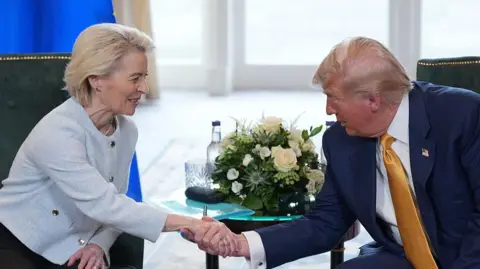
Trade tensions had previously eased after a deal was struck at Trump's Turnberry golf course in Scotland last July, setting US tariffs on most European goods at 15%, a notable drop from the 30% he initially threatened. In return, Europe agreed to invest in the US and amend certain conditions that would help bolster US exports.
Despite the trade deal's apparent progress, it required final approval from the European Parliament.
In light of Trump's new tariff threats related to Greenland, Bernd Lange, chair of the European Parliament's International Trade Committee, stated that the Parliament was left with no option but to halt all progress on the legislative proposals originally stemming from the Turnberry agreement. He emphasized that no further steps would be taken until the US resumed a stance of cooperation rather than confrontation.
Such a suspension opens the door for the EU to potentially revive previously announced tariffs targeting around €93bn ($109bn, £81bn) worth of American goods, which had been paused while the trade deal was being finalized. If the deal doesn’t receive approval or an extension to the pause, these tariffs could be implemented by February 7.
Lange indicated that any possibility of compromise was null until Trump's threats came to an end, raising the specter of the EU utilizing its anti-coercion instrument for retaliatory measures, which has garnered support from French President Emmanuel Macron.
While there were expectations regarding Trump's forthcoming clarity on Greenland, many European officials shared a general skepticism. Responses to Trump's announcements have ranged from cautious optimism to outright dismissal, with some EU sources expressing skepticism over any tangible outcomes.
In a speech at Davos, Trump reiterated his interest in acquiring Greenland from Denmark, underscoring that he seeks immediate negotiations without resorting to force. This assertion, along with the announcement of a framework for discussions, seemed to help stabilize financial markets that had earlier dipped due to uncertainty.
However, as Trump navigates these issues, the EU remains poised for further action should negotiations fail to foster greater cooperation, reflecting the broader implications on global trade dynamics amidst this evolving situation.