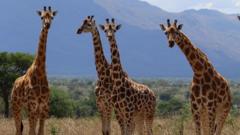
The findings reveal that the Southern giraffe, Reticulated giraffe, Northern giraffe, and Masai giraffe each have adapted to specific geographical barriers across Africa, leading to their evolution as separate species. Specifically, the Southern giraffe inhabits southern Africa, separated by rivers and rainforests, while the Reticulated giraffe is found primarily in Kenya and is a migratory species. The Northern giraffe occupies regions of eastern Africa, with the Nile River and Lake Victoria influencing its distinct migration path. Lastly, the Masai giraffe, famous for its patterned coat, resides in Kenya, Tanzania, and Uganda, also influenced by its geographic boundaries.
With giraffes classified under these four species, the IUCN is set to reassess both their conservation status and the challenges they face. With previous classifications deeming them vulnerable to extinction, the new taxonomic insights will enhance strategies aiming to preserve these iconic mammals, marking a crucial step towards their safeguarding for future generations. As co-author Michael Brown noted, improved classification facilitates effective conservation management, underscoring the importance of genetic understanding in wildlife protection.
In summary, this new discovery opens pathways for better conservation efforts designed to protect giraffes and highlights the necessity of understanding the complexities of their taxonomy in our quest for biodiversity.
With giraffes classified under these four species, the IUCN is set to reassess both their conservation status and the challenges they face. With previous classifications deeming them vulnerable to extinction, the new taxonomic insights will enhance strategies aiming to preserve these iconic mammals, marking a crucial step towards their safeguarding for future generations. As co-author Michael Brown noted, improved classification facilitates effective conservation management, underscoring the importance of genetic understanding in wildlife protection.
In summary, this new discovery opens pathways for better conservation efforts designed to protect giraffes and highlights the necessity of understanding the complexities of their taxonomy in our quest for biodiversity.