In brief
Azerbaijan’s education ministry rolled out new uniform rules on 21 September that effectively banned hijabs in state schools, leading to the first mass protests in the country’s history. Students and mothers staged demonstrations in Baku and southern districts, confronting officials and demanding religious freedom. The ban has strained relations with Turkey, where Prime Minister’s advisers called the rules unacceptable and organised protests outside the Azerbaijani embassy. Tensions are heightened by the nation’s close ties with Israel and the concern over Iranian influence. In response, President Ilham Aliyev warned against foreign interference while the opposition faces imprisonment and state media suppression.
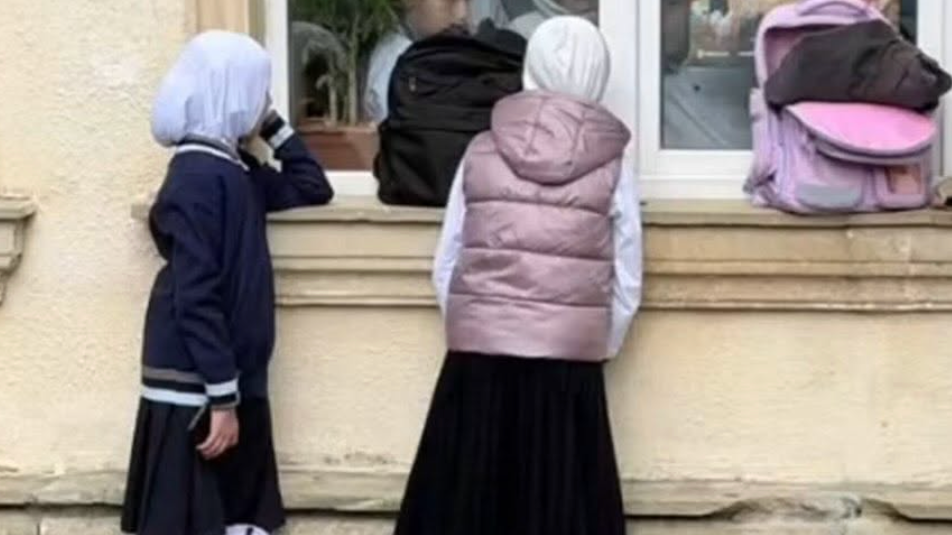
"You are telling me, I can’t come to school?" says a teenage girl in a navy blue Islamic headscarf, as she confronts a staff member at the entrance to her school in Baku. The video, which has spread across social media, shows a cluster of student girls in hijabs standing behind her, cheering as she repeats, "Why should I have to give up my religion?"
The footage captured the moment the education ministry began enforcing new uniform rules on Monday, turning away female pupils who were wearing hijabs. Since then, protests have erupted outside state schools in Baku and in southern districts such as Masally and Jalilabad. Rare in a 10.5 million‑person country known for its secular constitution, the demonstrations have cost several activists and parents a visit to the interior ministry, where 37 people were detained for allegedly “grossly violating public order”.
Russia’s President Ilham Aliyev has ruled Azerbaijan since 2003 and has repeatedly warned against dissent. Opposition politicians and many independent journalists are in prison, and the government tightly controls public expression. The new school uniform guidelines, approved on 21 September, ban any clothing that contradicts “the principle of secularism in education” in state schools, but do not mention the hijab by name. The same rules were extended to teachers on 6 October.
Azerbaijan balances relations between its two neighbours, Turkey to the north and Iran to the south. The country is largely Shia – over 60 % of the population identifies as such – and its Turkish‑speaking population shares close cultural ties with Turkey, but differs theologically, with most Turks being Sunni. The hijab ban has thus raised questions about an Azerbaijani policy that some fear may seek to distance the nation from Islam‑based influences while simultaneously maintaining close economic and security relations with Israel, a key arms supplier to Baku.
The interior ministry said it had detained 37 people who tried to obstruct the new rules. In one video, pupils outside School No. 69 in Balakhany, just outside Baku, hold a banner reading, "The hijab does not prevent anyone from getting an education." Several parents, such as Shahiza Huseynova from the Mashtaga district, were detained after threatening the state to “either take off your child’s hijab and send them to school, or go to prison.”
Activist Ilkin Huseynov launched an online platform called Let Leyli Go to School to offer free lessons from volunteer teachers to students barred from class. According to friends, Huseynov vanished after being separated from his home with unidentified men, and his phone has been offline since. The platform’s Instagram page is now inaccessible, and users report difficulty accessing TikTok and Instagram without a virtual private network (VPN).
The protests have largely concentrated in religiously conservative neighbourhoods in Baku’s outskirts and in districts near the 765‑km (475‑mile) border with Iran, where the country’s economic ties and trans‑border ethnic group have raised concerns over Iranian influence. On 13 October, the State Service for Special Communications and Information Security reported a cyber‑attack on more than 100 state websites by a group called the 313 Team (Cyber Islamic Resistance). The incident came as Turkey’s government tried to distance itself from a “foreign hacker group” that threatened Azerbaijan’s digital infrastructure.
The Turkish protest movement, unlike Azerbaijan’s own muted public sphere, has let its concerns spill into diplomatic and media arenas. President Recep Tayyip Erdoğan, who has promoted a “pious generation,” has warned that “a headscarf is not an obstacle; it is a requirement of one’s faith!” His adviser Ottay Saral wrote on X that the restrictions were unacceptable and called on Azerbaijan to reverse the decision. Members of Turkey’s ruling AK Party joined these protests, staging small demonstrations outside the Azerbaijani embassy in Ankara and its consulate in Istanbul. The Baku authorities responded sharply, with the New Azerbaijan Party accusing Turkish officials of a defamatory campaign and urging that “no one should stick their noses into our way of life.”
Provisions for the uniform are shown on an official Azerbaijani government video that lists acceptable garments, but these samples explicitly leave out hijabs. The school’s dress code highlights white shirts, blouses, skirts or pants, all lacking clear allowances for headscarves. The government’s insistence on secular dress, coupled with its high mounting security ties to Israel and planet‑wide strategic concerns, has eased tensions in the region, but only at the cost of domestic civil liberties. As the new regulations take effect, the Azerbaijan government has not commented further on possible international repercussions, while Baku’s rule‑by‑strength approach to dissent continues to be closely monitored by both local and foreign observers."