In brief
Discovered in July 2025, 3I/ATLAS could be the oldest comet ever observed, potentially possessing a significant amount of water ice. As it approaches the Sun, its unique characteristics excite researchers hoping to learn more about our galaxy's history.
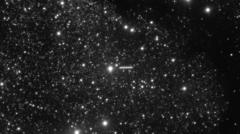
A remarkable interstellar object, designated 3I/ATLAS, has been identified by astronomers and could potentially be the oldest comet ever observed, with implications that it may be three billion years older than the solar system itself. This exciting discovery was shared by a research team from Oxford University during a recent presentation at the UK's Royal Astronomical Society meeting.Located approximately 670 million kilometers from the Sun when first detected on July 1, 2025, by the ATLAS survey telescope in Chile, 3I/ATLAS marks only the third occasion that humanity has witnessed an object originating from beyond our solar system. Oxford astronomer Matthew Hopkins, who recently completed his Ph.D., expressed enthusiasm about the find, affirming that it could be over seven billion years old and heralds unprecedented insights into interstellar bodies.Research indicates that 3I/ATLAS may have originated from the "thick disk" of the Milky Way, a region populated by ancient stars. This connection suggests that the object is likely composed of significant amounts of water ice, leading to the anticipation that, upon nearing the Sun later this year, the surge in solar energy could trigger mesmerizing displays of vapor and dust, potentially forming a tail.Alongside Professor Chris Lintott, co-author of the study, Hopkins emphasized the unprecedented nature of this galactic object, estimating a two-thirds probability that 3I/ATLAS is indeed older than the solar system. The upcoming months are pivotal, as amateur astronomers may soon have the opportunity to observe 3I/ATLAS from Earth.As the astronomical community gears up for a new observational phase using the cutting-edge Vera C. Rubin telescope in Chile, set to survey the southern night sky soon, expectations are high. Researchers hope this powerful tool could lead to the discovery of an impressive array of interstellar objects, with estimates ranging from five to fifty new findings.