In brief
In Germany's recent elections, Friedrich Merz's conservative party secured a leading position with 28.6% of the vote, while the far-right AfD achieved a record 20.8%. With high voter turnout, the results suggest a desire for change among the electorate, as mainstream parties face challenges in formulating coalitions.
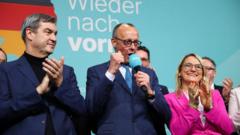
In Germany's latest elections, the political landscape has shifted dramatically as conservatives led by Friedrich Merz celebrated victories while the far-right Alternative for Germany (AfD) marked a historic milestone. Merz's Christian Democrats won approximately 28.6% of the votes, falling short of the anticipated 30%, but enough to assert their dominance among rival parties. He addressed supporters with enthusiasm, stating, “Let’s celebrate tonight and in the morning we’ll get to work,” while also acknowledging the considerable responsibilities that lie ahead.On the other hand, the AfD, despite receiving a record 20.8% of the vote and outperforming expectations, expressed mixed feelings as they had hoped for an even stronger result. AfD’s chancellor candidate, Alice Weidel, remarked, “Germans have voted for change,” indicating the party's established foothold, particularly in Eastern Germany where they projected as much as 34%. However, she predicted complications for a future coalition, suggesting that fresh elections might be on the horizon.The German electorate demonstrated a robust turnout of 83%, reminiscent of pre-reunification levels, yet Merz's Christian Democrats struggled to secure a more commanding lead. The election results reflect a shift in political allegiances, with the ruling Social Democrats suffering their worst defeat at 16.4%. Outgoing Chancellor Olaf Scholz announced his withdrawal from coalition negotiations, paving the way for Merz to navigate potential alliances.Merz has ruled out collaborating with the AfD due to a "firewall" against far-right parties, making the coalition-building process uncertain, especially given the lackluster Christian Democratic performance. The only plausible allies are the Greens, who Merz had disparaged prior to the elections.Notably, the election followed a backdrop of increased international attention, with figures like Elon Musk and U.S. Vice-President JD Vance being accused of meddling. Conversely, former President Donald Trump expressed support for Merz’s conservative approach, highlighting a wider trend of right-wing populism across transatlantic politics.As Merz sets his sights on strengthening Germany's position in Europe and tackling domestic issues from the economy to migration, challenges loom ahead. Younger voters remain unattached to traditional parties, gravitating instead towards the far-right and other alternatives like the Left, which surged close to 9% in recent polls. The evolving political dynamics reflect a society grappling with significant changes and demands for new solutions in the years to come.