In brief
Sienna Rose, a seemingly independent artist with millions of streams on Spotify, may not be who or what she appears to be. Streaming platforms have flagged her music as AI-generated, raising ethical concerns about the authenticity and soul of modern music. The mystery surrounding her existence taps into larger issues of AI's infiltration into the creative fields, with listeners debating whether the allure of her songs is genuine or artificially constructed.
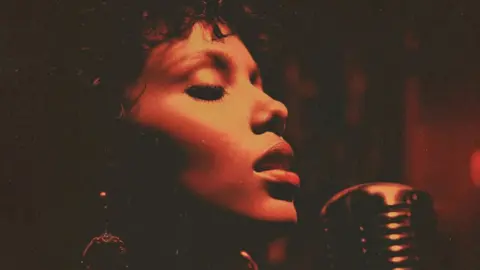
Sienna Rose is having a good month. Three of her dusky, jazz-infused soul songs are in Spotify's Viral Top 50. The most popular, a dreamy ballad called Into The Blue, has been played more than five million times. If she continues on this trajectory, Rose could become one of the year's hottest new stars.
There's only one problem: All the signs indicate she's not real.
Streaming service Deezer, which has developed tools to tackle AI music, told the BBC that many of her albums and songs on the platform are detected and flagged as computer generated.
Rose has no social media presence, has never played a gig, and has released an improbable number of songs in a short span. Between 28 September and 5 December, she uploaded at least 45 tracks to streaming services.
Her Instagram account, currently deactivated, featured an eerily uniform series of headshots, typical of AI image generation.
Listeners have noted AI artefacts in her music, such as a constant hiss that signals tracks generated by AI applications. These characteristics allow platforms like Deezer to identify her songs as AI-generated.
Critics of the phenomenon wonder if Sienna Rose is simply a creation of software, raising broader questions on the implications of AI in the music industry. With 34% of songs uploaded to Deezer potentially being AI-generated, artists like Rose pose a challenge to the authenticity of music, leading to a growing debate about what constitutes real artistry.
As the influence of AI grows, so does the concern among listeners and artists about the kindness and emotion perceived in human-created music compared to its algorithmic counterparts.
Despite speculation about her identity, some listeners prefer the music of Sienna Rose, while others express disappointment at the potential revelation that her art may not come from a real individual.