
In brief
As Xi Jinping and Vladimir Putin showcase their friendship publicly, a deeper, more competitive dynamic simmers beneath the surface of their relationship, revealing the challenges and complexities faced by both nations today.
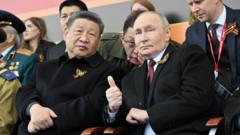
In a striking display of camaraderie, Chinese President Xi Jinping joined his Russian counterpart Vladimir Putin in Moscow for the Victory Day parade, reinforcing their alliance with symbolic gestures and proclamations of friendship. Seated at Putin’s right side, Xi asserted that the bond between China and Russia is "unbreakable," dubbing the two nations as "friends of steel." This occasion marked Xi's eleventh visit to Russia since he took office in 2013, illustrating their extensive diplomatic interactions over more than 40 meetings.However, experts point out that their public displays may mask underlying complexities. Mathieu Boulegue from the Center for European Policy Analysis noted that while Xi and Putin engage in patriotic exchanges, their relationship incorporates elements of competition, as well as cooperation, making its true nature harder to decipher. China’s partnership with Russia is pivotal; yet, the geopolitical climate poses challenges. Putin's status as an international pariah—particularly due to the invasion of Ukraine—compels China to navigate this alliance carefully to avoid jeopardizing its own standing and relations with other nations, especially Europe. Recently, Xi has been working to solidify diplomatic ties with European leaders, further complicating his alliance with Russia.Despite its past support, China's position on the conflict in Ukraine has been conspicuously neutral, shying away from outright condemnation of Russia. A close relationship with Moscow could lead to friction with potential allies within Europe, as the continent seeks stability amidst the turmoil. Analysts argue that Xi's cautious approach aims to demonstrate to the U.S. that attempts to drive a wedge between China and Russia are futile, stating in Russian media, "Together, we must foil all schemes to disrupt or undermine our bonds of amity and trust."Yet, as Xi acknowledges, the power dynamics in their partnership have shifted. In light of Western sanctions, which have deeply weakened Russia’s economy and military, it’s become clear that China holds more leverage in this relationship. In comments highlighting the emerging global landscape, Boulegue noted, "Russia needs China much more than the opposite is true.”As both leaders continue to navigate their alliance, the external pressures and potential discord in their relationship could pose challenges to their long-term partnership, as they strive to project a united front against perceived U.S. hegemony and establish an alternative world order. While the public displays of friendship may captivate observers, the reality of their strategic alliance may prove to be much more intricate.
