In brief
A prominent UN environmental report has been criticized for being manipulated by several countries, most notably the US, which refused to endorse its critical conclusions on climate change and fossil fuel reliance. Co-chair Sir Robert Watson highlighted that the report, which connects climate change and pollution to unsustainable consumption, was released without an agreed summary due to disagreements at a high-level meeting. This raises concerns for future climate negotiations.
A key UN report on the state of the global environment has been hijacked by the United States and other countries who were unwilling to go along with the scientific findings, the co-chair has told the BBC.
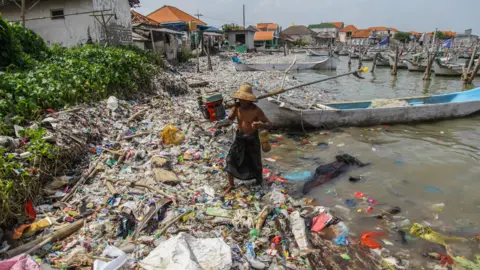
The Global Environment Outlook, the result of six years' work, connects climate change, nature loss, and pollution to unsustainable consumption by people living in wealthy and emerging economies.
It warns of a dire future for millions unless there's a rapid move away from coal, oil, and gas and fossil fuel subsidies.
But at a meeting with government representatives to agree the findings, the US and allies said they could not go along with a summary of the report's conclusions.
As the scientists were unwilling to water down or change their findings, the report has now been published without the summary and without the support of governments, weakening its impact.
Researchers say the objections to this new report reflect similar concerns expressed by countries at the recent COP30 talks.
Issued every six or seven years, the Global Environment Outlook is a significant scientific analysis of the major threats to the planet. Developed under the auspices of the UN, the normal practice for studies like this is to have the key conclusions and recommendations agreed word by word with governments and published as a summary for policymakers.
However, this new version of the Global Environment Outlook does not have this type of summary, as the authors and the political representatives of around 70 countries could not agree one at a stormy meeting in Nairobi in October.
Compiled by nearly 300 scientists worldwide, the report argues that the food we eat, the clothes we wear, and the energy we consume all involve the extraction of resources in a highly unsustainable manner.
To solve the connected issues of climate change, pollution, nature, and biodiversity loss, the report has many recommendations including a rapid move away from coal, oil, and gas and a massive reduction in subsidies for farming and fossil fuels. The authors acknowledge this type of action will drive up prices for consumers.
But that short-term pain will bring long-term economic benefits for the whole world, the report says. These strong measures, especially on fossil fuels and plastics, were too much for the United States, Saudi Arabia, and Russia among others at the approval meeting, which usually works by consensus.
A small number of countries basically just hijacked the process, to be quite honest, Prof Sir Robert Watson told BBC News.
The US decided not to attend the meeting at all. At the very end they joined by teleconference and basically made a statement that they could not agree with most of the report, which means they didn't agree with anything we said on climate change, biodiversity, fossil fuels, plastics, and subsidies.
Sir Robert is one of the world's most respected scientific voices. He's a former chief scientist for the UK's department of the environment and has also been chair of the Intergovernmental Panel on Climate Change (IPCC), as well as working for the World Bank and NASA.
However, he has had rows with the US in the past, criticizing their decision to leave an earlier climate treaty, the Kyoto Protocol when he was head of the IPCC. He was ousted from that role in 2002 after lobbying by the administration of President George W. Bush.
Others present at the meeting agreed that the actions of the US and other countries derailed the process. I thought we had gone beyond the point of recognizing that when you burn oil, this big, thick black stuff comes up, and it probably isn't good, especially when you try and breathe it in, said Dr David Broadstock, with the Lantau Group, and one of the report's lead authors.
Since taking office President Trump has sought to boost fossil fuel production and roll back US commitments to fight climate change, calling for the country to be a global energy superpower with cheap and reliable resources.
This year has seen efforts at international plastics negotiations, at the international maritime organization, and during COP30 to strike out language that states that climate change is a major issue requiring the world to move away rapidly from fossil fuels.
The disagreement over the Global Environment Outlook report will raise concerns about future negotiations for the Intergovernmental Panel on Climate Change reports as these studies are seen as the bedrock of global efforts to limit global warming.