
In brief
As tourists flock to explore stunning sinkholes housing untouched ancient forests, conservationists warn of the risks posed to these delicate environments and urge for protective measures.
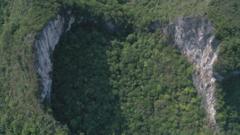
In the remote Guangxi province of China, a network of breathtaking sinkholes, or "tiankeng," has transitioned from myth-laden realms of potential danger to vibrant tourist hotspots. Standing at the edge of a sheer limestone cliff, visitors gaze into a vast chasm over 100 meters deep, where ancient forests, teeming with rare flora and fauna, lay hidden beneath leafy canopies, accompanied by haunting sounds of cicadas. These incredible geological formations are a geographic marvel, with over two-thirds of the world's known sinkholes found in China, predominantly concentrated in Guangxi. The region’s allure was amplified two years ago when explorers discovered a previously untouched forest, with towering trees reaching heights of 130 feet. While these sinkholes serve as living laboratories for scientists, representing preserved ecosystems, their newfound popularity poses a threat to their integrity.For many visitors, like 25-year-old Rui and her boyfriend Michael, the excitement of rappelling into these remarkable geological formations presents an uncharacteristic thrill. Fei Ge, a local guide fondly known as Brother Fei, grew up in the shadows of these sinkholes, initially taught to avoid them due to superstitions of lurking spirits. However, his curiosity led him to become one of the first explorers to descend into their depths, uncovering ecosystems that had gone unnoticed for centuries. The collapsing limestone that creates these sinkholes not only produces dramatic landscapes but also sustains rare species, some of which are believed to have existed since the time of the dinosaurs. Experts have recently identified new species within these caverns, including orchids and unique cave-dwelling creatures. With increasing scientific interest comes the risk of overexploitation, as developers see opportunities to profit from the influx of ecotourism. This is evident near Ping’e village, where infrastructure projects are on the rise, yet locals like Brother Fei emphasize the necessity of sustainable practices to preserve their heritage.While the economic boost from tourism has the potential to uplift the region, experts caution against the long-term ecological consequences. Dr. Lina Shen, an esteemed sinkhole researcher, calls for a measured approach, advocating for protective measures to ensure the survival of endangered species residing within these microclimates. Initiatives like observing sinkholes through drones or designing limited-access pathways could mitigate harm while still encouraging an appreciation for nature's wonders.As the sinkholes increasingly attract adventurous tourists, balancing the allure of exploration with the responsibility of conservation remains a critical challenge. Rui and Michael’s journey into the depths not only enriches their travel experience but also raises awareness of the importance of protecting these extraordinary habitats for future generations. In their descent, they become part of a broader narrative— one that seeks to harmonize the thrill of exploration with the gentler hand of stewardship for China's magnificent and endangered natural treasures.
